Advertisements
Advertisements
प्रश्न
State the effects that a force can produce. Given one example of each.
Advertisements
उत्तर
A force can produce the following three effects:
(i) It can bring changes in dimensions. For example, in stretching a spring its length increases.
(ii) It can start or stop motion. For example, a ball moves when kicked.
(iii) It can change the speed or direction of motion. For example, a hockey player changes the speed and direction of the motion of the ball by his stick.
संबंधित प्रश्न
It is easier to open the door by pushing it at its free end.
Find the moment of force of 20 N about an axis of rotation at distance 0.5 m from the force.
State one way to obtain greater moment of a given force about a given axis of rotation.
A steering wheel of diameter 0.5 m is rotated anticlockwise by applying two forces each of magnitude 6 N. Draw a diagram to show the application of forces and calculate the moment of forces applied.
Give an example of the following uses of a machine:
to change the direction of force
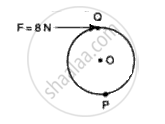
A wheel of diameter 3 m is shown in fig. 2 with axle at 0. A force F = 8 N is applied at Q in the direction shown in figure. Calculate the moment of force about:
(i) centre o, and
(ii) point p.
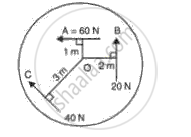
Three forces A, B and C are acting on a rigid body which can turn about O in fig.9. If all the three forces are applied simultaneously, in which direction will the body move? Explain.
Under what condition will a set of gears produce a gain in torque.
The perpendicular distance between the point of application of force and turning point is 1.75 m when a force of 80 N acts on a rigid body. Calculate the moment of force.
The diagram in Fig shows two forces F1 = 5 N and F2 = 3 N acting at points A and B respectively of a rod pivoted at a point O, such that OA = 2 m and OB = 4 m.
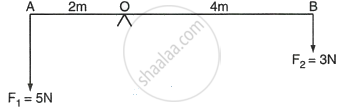
Calculate:
- the moment of force F1 about O.
- the moment of force F2 about O.
- total moment of the two forces about O.
