Solve the following system of equations by the method of cross-multiplication: mx – ny = m^2 + n^2 x + y = 2m
Advertisements
Question
Solve the following system of equations by the method of cross-multiplication:
mx – ny = m2 + n2
x + y = 2m
Advertisements
Solution
The given system of equations may be written as
`mx - ny - (m^2 + n^2) = 0`
`x + y - 2m = 0`
Here
`a_1 = m, b_1 = -n, c_1 = -(n^2 + n^2)`
`a_2 = 1, b_2 = 1, c_2 = -2m`
By cross multiplication, we have
`x/(2mn + (m^2 + n^2)) = (-y)/(-2m^2 + (m^2 + n^2)) = 1/(m + n)`
`=> x/(2mn + m^2 + n^2) = (-y)/(-m^2 + n^2) = 1/(m + n)`
`=> x/(m + n)^2 = (-y)/(-m^2 + n^2) = 1/(m + n)`
Now
`x/(m + n)^2 = 1/(m + n)`
`=> x = (m + n^2)/(m + n)`
`=> x = m + n`
And
`(-y)/(-m^2 + n^2) = 1/(m + n)`
`=> -y = (-m^2 + n^2)/(n + n)`
`=> y = (m^2 - n^2)/(m + n)`
`=> y = ((m - n)(m + n))/(m + n)`
`=> y = m - n`
Hence, x = m + n, y = m - n is the solution of the given system of equations.
APPEARS IN
RELATED QUESTIONS
A thief runs with a uniform speed of 100 m/minute. After one minute, a policeman runs after the thief to catch him. He goes with a speed of 100 m/minute in the first minute and increases his speed by 10 m/minute every succeeding minute. After how many minutes the policeman will catch the thief.
Solve the following system of equations by cross-multiplication method.
2x + 3y + 8 = 0
4x + 5y + 14 = 0
Which of the following pairs of linear equations has unique solution, no solution, or infinitely many solutions. In case there is a unique solution, find it by using cross multiplication method.
x – 3y – 7 = 0
3x – 3y – 15 = 0
Solve the following systems of equations:
`2x - 3/y = 9`
`3x + 7/y = 2, y != 0`
Solve the following systems of equations:
`1/(7x) + 1/(6y) = 3`
`1/(2x) - 1/(3y) = 5`
Solve each of the following systems of equations by the method of cross-multiplication :
2x + y = 35
3x + 4y = 65
Solve the following system of equations by the method of cross-multiplication:
ax + by = a – b
bx – ay = a + b
Solve each of the following systems of equations by the method of cross-multiplication
`x/a + y/b = a + b`
Solve each of the following systems of equations by the method of cross-multiplication
`x/a = y/b`
`ax + by = a^2 + b^2`
Solve the following system of equations by the method of cross-multiplication:
(a + 2b)x + (2a – b)y = 2
(a – 2b)x + (2a + b)y = 3
Solve the following system of equations by the method of cross-multiplication:
bx + cy = a + b
`ax(1/(a - b) - 1/(a + b)) + cy(1/(b - a) - 1/(b + a)) = (2a)/(a + b)`
Solve the following system of equations by the method of cross-multiplication:
`(ax)/b - (by)/a = a + b`
ax – by = 2ab
Solve the system of equations by using the method of cross multiplication:
6x – 5y – 16 = 0, 7x – 13y + 10 = 0
Find the values of x and y in the following rectangle [see figure].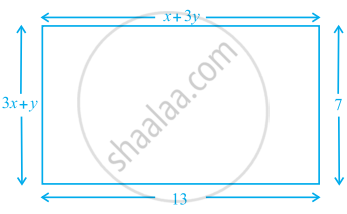
Solve the following pair of equations:
43x + 67y = – 24, 67x + 43y = 24
Determine, algebraically, the vertices of the triangle formed by the lines
3x – y = 2
2x – 3y = 2
x + 2y = 8
A motor boat can travel 30 km upstream and 28 km downstream in 7 hours. It can travel 21 km upstream and return in 5 hours. Find the speed of the boat in still water and the speed of the stream.
A two-digit number is obtained by either multiplying the sum of the digits by 8 and then subtracting 5 or by multiplying the difference of the digits by 16 and then adding 3. Find the number.
For what values of k will the following pair of linear equations have infinitely many solutions?
kx + 3y – (k – 3) = 0
12x + ky – k = 0
Anuj had some chocolates, and he divided them into two lots A and B. He sold the first lot at the rate of ₹ 2 for 3 chocolates and the second lot at the rate of ₹ 1 per chocolate, and got a total of ₹ 400. If he had sold the first lot at the rate of ₹ 1 per chocolate, and the second lot at the rate of ₹4 for 5 chocolates, his total collection would have been ₹460. Find the total number of chocolates he had.
