Solve the following system of equations by the method of cross-multiplication: (ax)/b – (by)/a = a + b ax – by = 2ab
Advertisements
Question
Solve the following system of equations by the method of cross-multiplication:
`(ax)/b - (by)/a = a + b`
ax – by = 2ab
Advertisements
Solution
The given system of the equation may be written as
`a/b x xx - b/a xx y - (a + b) = 0`
ax - by - 2ab = 0
Here
`a_1 = a/b, b_1 = - b/a, c_1 = -(a + b)`
`=> x/(2b^2 - ab - b^2) = (-y)/(-2a^2 + a^2 + ab) = 1/(-a + b)`
`=> x/(b^2 -ab) = (-y)/(-a^2 + ab) = 1/(-a + b)`
`=> x/(b(b -a)) = (-y)/(a(-a + b)) = 1/(b - a)`
Now
`x/(b(b - a)) = 1/(b -a)`
`=> x = (b(b -a ))/(b -a) = b`
And
`=> -y = (a(b - a))/(b -a)`
`=> -y = a`
`=> y = -a`
Hence, x = b, y = -a is the solution of the given system of equations.
APPEARS IN
RELATED QUESTIONS
Solve the following system of equations by cross-multiplication method x + y = a – b; ax – by = a2 + b2
Solve the following system of equations in x and y by cross-multiplication method
`(a – b) x + (a + b) y = a^2 – 2ab – b^2`
`(a + b) (x + y) = a^2 + b^2`
Form the pair of linear equations in the following problems and find their solutions (if they exist) by any algebraic method:
A fraction becomes `1/3` when 1 is subtracted from the numerator and it becomes `1/4` when 8 is added to its denominator. Find the fraction.
Form the pair of linear equations in the following problems and find their solutions (if they exist) by any algebraic method:
Yash scored 40 marks in a test, getting 3 marks for each right answer and losing 1 mark for each wrong answer. Had 4 marks been awarded for each correct answer and 2 marks been deducted for each incorrect answer, then Yash would have scored 50 marks. How many questions were there in the test?
Form the pair of linear equations in the following problems and find their solutions (if they exist) by any algebraic method:
Places A and B are 100 km apart on a highway. One car starts from A and another from B at the same time. If the cars travel in the same direction at different speeds, they meet in 5 hours. If they travel towards each other, they meet in 1 hour. What are the speeds of the two cars?
Solve the following system of equations by the method of cross-multiplication:
ax + by = a – b
bx – ay = a + b
Solve each of the following systems of equations by the method of cross-multiplication :
`x(a - b + (ab)/(a - b)) = y(a + b - (ab)/(a + b))`
`x + y = 2a^2`
Solve each of the following systems of equations by the method of cross-multiplication
`a^2x + b^2y = c^2`
`b^2x + a^2y = d^2`
Solve the following system of equations by the method of cross-multiplication:
2(ax – by) + a + 4b = 0
2(bx + ay) + b – 4a = 0
Solve the following system of equations by the method of cross-multiplication:
mx – ny = m2 + n2
x + y = 2m
Solve the system of equations by using the method of cross multiplication:
2x + 5y – 1 = 0, 2x + 3y – 3 = 0
Solve the system of equations by using the method of cross multiplication:
2x + y – 35 = 0, 3x + 4y – 65 = 0
Solve the system of equations by using the method of cross multiplication:
`1/x + 1/y = 7, 2/x + 3/y = 17`
Solve the system of equations by using the method of cross multiplication:
2ax + 3by – (a + 2b) = 0, 3ax + 2by – (2a + b) = 0
A father’s age is three times the sum of the ages of his two children. After 5 years his age will be two times the sum of their ages. Find the present age of the father.
Find the values of x and y in the following rectangle [see figure].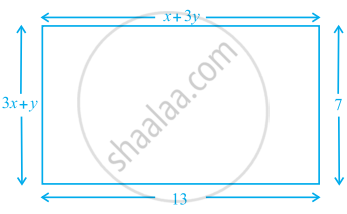
Solve the following pair of equations:
x + y = 3.3, `0.6/(3x - 2y) = -1, 3x - 2y ≠ 0`
Solve the following pair of equations:
`1/(2x) - 1/y = -1, 1/x + 1/(2y) = 8, x, y ≠ 0`
A motor boat can travel 30 km upstream and 28 km downstream in 7 hours. It can travel 21 km upstream and return in 5 hours. Find the speed of the boat in still water and the speed of the stream.
Anuj had some chocolates, and he divided them into two lots A and B. He sold the first lot at the rate of ₹ 2 for 3 chocolates and the second lot at the rate of ₹ 1 per chocolate, and got a total of ₹ 400. If he had sold the first lot at the rate of ₹ 1 per chocolate, and the second lot at the rate of ₹4 for 5 chocolates, his total collection would have been ₹460. Find the total number of chocolates he had.
