Advertisements
Advertisements
Questions
Find the values of x and y in the following rectangle [see figure].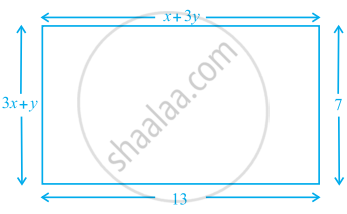
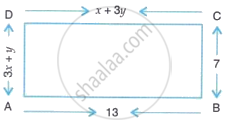
Find the values of x and y in the following rectangle.
Advertisements
Solution
Using property of rectangle,
We know that,
Lengths are equal,
i.e., CD = AB
Hence, x + 3y = 13 ......(i)
Breadth are equal,
i.e., AD = BC
Hence, 3x + y = 7 ......(ii)
On multiplying equation (ii) by 3 and then subtracting equation (i), we get
9x + 3y = 21
x + 3y = 13
– – –
8x = 8
So, x = 1
On substituting x = 1 in equation (i), we get
3y = 12
y = 4
Therefore, the required values of x and y are 1 and 4, respectively.
RELATED QUESTIONS
A motorboat whose speed in still water is 18 km/h, takes 1 hour more to go 24 km upstream than to return downstream to the same spot. Find the speed of the stream.
Solve the following system of equations by the method of cross-multiplication:
`\frac{x}{a} + \frac{y}{b} = a + b; \frac{x}{a^{2}} + \frac{y}{b^{2}} = 2`
Which of the following pairs of linear equations has unique solution, no solution or infinitely many solutions? In case there is a unique solution, find it by using cross multiplication method
2x + y = 5
3x + 2y = 8
Solve the following systems of equations:
`1/(2x) + 1/(3y) = 2`
`1/(3x) + 1/(2y) = 13/6`
Solve the following system of equations by the method of cross-multiplication:
3x + 2y + 25 = 0
2x + y + 10 = 0
Solve each of the following systems of equations by the method of cross-multiplication :
2x + y = 35
3x + 4y = 65
Solve each of the following systems of equations by the method of cross-multiplication
2x − y = 6
x − y = 2
Solve the following system of equations by the method of cross-multiplication:
ax + by = a – b
bx – ay = a + b
Solve each of the following systems of equations by the method of cross-multiplication :
`x(a - b + (ab)/(a - b)) = y(a + b - (ab)/(a + b))`
`x + y = 2a^2`
Solve the following system of equations by the method of cross-multiplication:
mx – ny = m2 + n2
x + y = 2m
Solve the following system of equations by the method of cross-multiplication:
`(ax)/b - (by)/a = a + b`
ax – by = 2ab
Solve the system of equations by using the method of cross multiplication:
3x – 2y + 3 = 0, 4x + 3y – 47 = 0
Solve the system of equations by using the method of cross multiplication:
`x/6 + y/15 - 4 = 0, x/3 - y/12 - 19/4 = 0`
Solve the system of equations by using the method of cross multiplication:
2ax + 3by – (a + 2b) = 0, 3ax + 2by – (2a + b) = 0
Solve the following pair of equations:
`x/3 + y/4 = 4, (5x)/6 - y/4 = 4`
Solve the following pair of equations:
`4x + 6/y = 15, 6x - 8/y = 14, y ≠ 0`
Determine, algebraically, the vertices of the triangle formed by the lines
3x – y = 2
2x – 3y = 2
x + 2y = 8
A motor boat can travel 30 km upstream and 28 km downstream in 7 hours. It can travel 21 km upstream and return in 5 hours. Find the speed of the boat in still water and the speed of the stream.
