Advertisements
Advertisements
Question
Solve each of the following systems of equations by the method of cross-multiplication
`x/a = y/b`
`ax + by = a^2 + b^2`
Advertisements
Solution
`x/a = y/b`
``ax + by = a^2 + b^2`
Here `a_1 = 1/a, b_1 = (-1)/b, c_1 = 0`
`a_2 = a, b_2 = b,c_2 = -(a^2 + b^2)`
By cross multiplication, we get
`x/(-1/b(-(a^2 + b^2))-b(0)) = (-y)/(1/a(-(a^2 + b^2))-a(0)) = 1/(1/a (b) - a xx ((-1)/b))`
`x/((a^2 + b^2)/b) = y/((a^2 + b^2)/a) = 1/(b/a + a/b)`
`x = ((a^2 + b^2)/b)/(b/a + a/b) = ((a^2 +b^2)/b)/((b^2 + a^2)/(ab)) = a`
`y = ((a^2 + b^2)/a)/(b/a + a/b) = ((a^2 + b^2)/b)/((b^2+a^2)/(ab)) = b`
Solution is (a, b)
RELATED QUESTIONS
A train travels at a certain average speed for a distance of 54 km and then travels a distance of 63 km at an average speed of 6 km/h more than the first speed. If it takes 3 hours to complete the total journey, what is its first speed?
Solve the following system of equations by cross-multiplication method x + y = a – b; ax – by = a2 + b2
Solve the following system of equations by the method of cross-multiplication. `\frac{a}{x}-\frac{b}{y}=0;\text{}\frac{ab^{2}}{x}+\frac{a^{2}b}{y}=a^{2}+b^{2};` Where x ≠ 0, y ≠ 0
Which of the following pairs of linear equations has unique solution, no solution or infinitely many solutions? In case there is a unique solution, find it by using cross multiplication method
2x + y = 5
3x + 2y = 8
Solve the following systems of equations:
`x + 2y = 3/2`
`2x + y = 3/2`
Solve the following systems of equations:
`2x - 3/y = 9`
`3x + 7/y = 2, y != 0`
Solve the following system of equations:
`(7x - 2y)/(xy) = 5`
`(8x + 7y)/(xy) = 15`
Solve the following system of equations by the method of cross-multiplication:
`(x + y)/(xy) = 2`
`(x - y)/(xy) = 6`
Solve each of the following systems of equations by the method of cross-multiplication
`x/a + y/b = 2`
`ax - by = a^2 - b^2`
Solve each of the following systems of equations by the method of cross-multiplication :
`2/x + 3/y = 13`
`5/4 - 4/y = -2`
where `x != 0 and y != 0`
Solve the following system of equations by the method of cross-multiplication:
(a + 2b)x + (2a – b)y = 2
(a – 2b)x + (2a + b)y = 3
Solve the following system of equations by the method of cross-multiplication:
`(a - b)x + (a + b)y = 2a^2 - 2b^2`
(a + b)(x + y) = 4ab
Solve the system of equations by using the method of cross multiplication:
x + 2y + 1 = 0, 2x – 3y – 12 = 0
Solve the system of equations by using the method of cross multiplication:
`5/(x + y) - 2/(x - y) + 1 = 0, 15/(x + y) + 7/(x - y) - 10 = 0`
Complete the activity to find the value of x.
3x + 2y = 11 ...(i) and 2x + 3y = 4 ...(ii)
Solution:
Multiply equation (i) by ______ and equation (ii) by ______.
`square` × (3x + 2y = 11) ∴ 9x + 6y = 33 ...(iii)
`square` × (2x + 3y = 4) ∴ 4x + 6y = 8 ...(iv)
Subtract (iv) from (iii),
`square` x = 25
∴ x = `square`
Find the values of x and y in the following rectangle [see figure].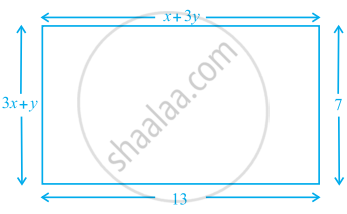
Solve the following pair of equations:
`x/3 + y/4 = 4, (5x)/6 - y/4 = 4`
Solve the following pair of equations:
`x/a + y/b = a + b, x/a^2 + y/b^2 = 2, a, b ≠ 0`
Find the solution of the pair of equations `x/10 + y/5 - 1 = 0` and `x/8 + y/6 = 15`. Hence, find λ, if y = λx + 5.
A railway half ticket costs half the full fare, but the reservation charges are the same on a half ticket as on a full ticket. One reserved first class ticket from the station A to B costs Rs 2530. Also, one reserved first class ticket and one reserved first class half ticket from A to B costs Rs 3810. Find the full first class fare from station A to B, and also the reservation charges for a ticket.
