Solve the following system of equations by the method of cross-multiplication: bx + cy = a + b ax(1/(a – b) – 1/(a + b)) + cy(1/(b – a) – 1/(b + a)) = (2a)/(a + b)
Advertisements
Question
Solve the following system of equations by the method of cross-multiplication:
bx + cy = a + b
`ax(1/(a - b) - 1/(a + b)) + cy(1/(b - a) - 1/(b + a)) = (2a)/(a + b)`
Advertisements
Solution
The given system of equations is
bx + cy = a + b .....(i)
`ax (1/(a - b) - 1/(a + b)) + cy(1/(b -a) - 1/(b + a)) = (2a)/(a + b)` ......(ii)
From equation (ii), we get
bx + cy – (a + b) = 0 .....(iii)
From equation (ii), we get
`ax[(a + b-(a-b))/((a - b)(a + b))] + cy((b + a - (b -a))/((b-a)(b + a))) - (2a)/(a + b) = 0`
`=> ax [(a + b - a + b)/((a - b)(a + b))] + cy((b + a - b + a)/((b -a)(b+a))) - (2a)/(a + b) = 0`
`=> ax[(2b)/(a - b)(a + b)] + cy((2a)/((b -a)(b+a))) - (2a)/(a + b) = 0`
`=> x [(2ab)/((a - b)(a + b))] + y((2ac)/((a - b)(a + b))) - (2a)/(a +b) = 0`
`=> 1/(a + b)[(2abx)/(a - b) - (2acy)/(a -b) - 2a] = 0`
`=> (2abx - 2acy - 2a(a - b))/(a - b) = 0`
`=> 2abx - 2acy - 2a(a - b) = 0` .....(iv)
From equation (i) and equation (ii), we get
`a_1 = b, b_1 = c, c_1 = -(a + b)`
`a_2 = 2ab,b_2 = -2ac, c_2 = -2a(a - b)`
By cross multiplication, we get
`=> x/(-2ac(a - b)-[-(a + b)][-2ac]) = (-y)/(-2ab(a - b)-[-(a + b)][2ab]) = 1/(-2abc - 2abc))`
`=> x/(-2a^2c + 2abc - 2a^2c - 2abc) = (-y)/(-2a^2b + 2ab^2 + 2ab^2b - 2ab^2) = (-1)/(4abc)`
`=> x/(-4a^2c) = (-y)/(4ab^2) = (-1)/(4abc)`
Now
`x/(-4a^2c) = (-1)/(4abc)`
`=> x = (4a^2c)/(4abc) = a/b`
And
`(-y).(4ab^2) = (-1)/(4abc)`
`=> y = (4ab^2)/(4abc) = b/c`
Hence `x = a/b, y = b/c` isthe soluiton of the given system of the equations.
APPEARS IN
RELATED QUESTIONS
Solve the follownig system of equations by the method of cross-multiplication.
2x – 6y + 10 = 0
3x – 7y + 13 = 0
Which of the following pairs of linear equations has unique solution, no solution, or infinitely many solutions. In case there is a unique solution, find it by using cross multiplication method
x – 3y – 3 = 0
3x – 9y – 2 = 0
Form the pair of linear equations in the following problems and find their solutions (if they exist) by any algebraic method :
A part of monthly hostel charges is fixed and the remaining depends on the number of days one has taken food in the mess. When a student A takes food for 20 days she has to pay Rs 1000 as hostel charges whereas a student B, who takes food for 26 days, pays Rs 1180 as hostel charges. Find the fixed charges and the cost of food per day.
Solve the following system of equations:
`x/3 + y/4 =11`
`(5x)/6 - y/3 = -7`
Solve the following systems of equations:
4u + 3y = 8
`6u - 4y = -5`
Solve the following systems of equations:
`x + 2y = 3/2`
`2x + y = 3/2`
Solve the following system of equations:
`3x - (y + 7)/11 + 2 = 10`
`2y + (x + 11)/7 = 10`
Solve the following systems of equations:
`2x - 3/y = 9`
`3x + 7/y = 2, y != 0`
Solve the following systems of equations:
`1/(2x) + 1/(3y) = 2`
`1/(3x) + 1/(2y) = 13/6`
Solve the following system of equations:
`4/x + 3y = 14`
`3/x - 4y = 23`
Solve the following system of equations by the method of cross-multiplication:
`(x + y)/(xy) = 2`
`(x - y)/(xy) = 6`
Solve the following system of equations by the method of cross-multiplication:
ax + by = a – b
bx – ay = a + b
Solve the following system of equations by the method of cross-multiplication:
`a^2/x - b^2/y = 0`
`(a^2b)/x + (b^2a)/y = a + b, x, y != 0`
Solve the following system of equations by the method of cross-multiplication:
`(ax)/b - (by)/a = a + b`
ax – by = 2ab
Solve each of the following systems of equations by the method of cross-multiplication :
`b/a x + a/b y - (a^2 + b^2) = 0`
x + y - 2ab = 0
Solve the system of equations by using the method of cross multiplication:
7x - 2y – 3 = 0,
`11x - 3/2 y – 8 = 0.`
Find the values of x and y in the following rectangle [see figure].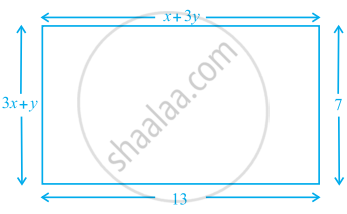
Solve the following pair of equations:
`4x + 6/y = 15, 6x - 8/y = 14, y ≠ 0`
Determine, algebraically, the vertices of the triangle formed by the lines
3x – y = 2
2x – 3y = 2
x + 2y = 8
Susan invested certain amount of money in two schemes A and B, which offer interest at the rate of 8% per annum and 9% per annum, respectively. She received Rs 1860 as annual interest. However, had she interchanged the amount of investments in the two schemes, she would have received Rs 20 more as annual interest. How much money did she invest in each scheme?
