Advertisements
Advertisements
Question
Show the structure of a renal corpuscle with the help of a diagram.
Advertisements
Solution

Malpighian body (renal corpuscle)
APPEARS IN
RELATED QUESTIONS
State if the following statement is true or false. Correct the statement if it is false.
Each kidney contains millions of microscopic filtering units called ureters.
Differentiate between
ureter and urethra.
Find the odd one out. Give a reason for your choice.
tannin, urine, latex, resin
Draw and label the diagram.
Human excretory system
Given below is the figure of certain organs and associated parts in the human body. Study the same and answer the question that follow:
Name the parts numbered 1 to 5.
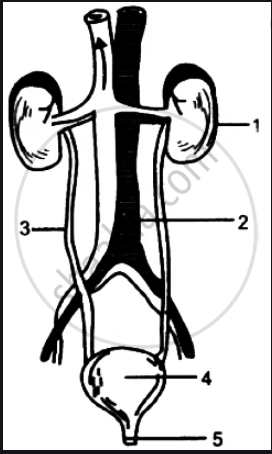
What kind of urine (concentration) is produced in the human body?
Explain the Term: Tubular reabsorption
Name the Following
Major excretory organs of man.
Name the Following
The product which is excreted by the liver.
Complete the following sentence with appropriate word:
The human liver converts ammonia into ______
Write the functional activity of the following structure: Bladder sphincter
Write the functional activity of the following structure: Iliac vein
The functional unit of kidney is ______.
Differentiate cortical from medullary nephrons.
Identify the labels (A-F) in the given diagram of excretory system in human beings.
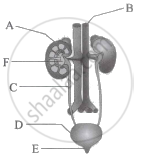
Where is the dirty blood in our body filtered?
______ is sac–like in shape.
The nitrogenous wastes are removed from the body by the endocrine system.
Name the process and the organ which helps in removing the following wastes from the body.
- Carbon dioxide
- Undigested food
- Urine
- Sweat
Define the following term:
Kidney
