Advertisements
Advertisements
प्रश्न
Show the structure of a renal corpuscle with the help of a diagram.
Advertisements
उत्तर

Malpighian body (renal corpuscle)
APPEARS IN
संबंधित प्रश्न
Ascending limb of Henle’s loop is ______ to water, whereas the descending limb is ______to it.
State if the following statement is true or false. Correct the statement if it is false.
Each kidney contains millions of microscopic filtering units called ureters.
Answer the following in detail.
How do skin and lungs help in excretion?
Excretion primarily involves
Given below is the figure of certain organs and associated parts in the human body. Study the same and answer the question that follow:
Name the two major steps involved in the formation of the fluid that passes down the part labeled '3'.

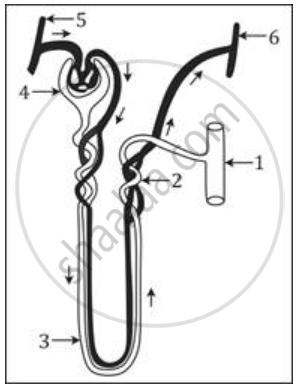
The given diagram represents a nephron and its blood supply. Study the diagram and answer the following question :
Name the two main stages of urine formation.
Give Reasons for the Following:
All living things must excrete.
Explain the Term: Urinary bladder
Name the Following
The product which is excreted by the liver.
Complete the following sentence with appropriate word:
The human liver converts ammonia into ______
Complete the following sentence with appropriate words:
Urine is collected in the ______.
Identify the wrong match
Identify the CORRECT statement.
Urethra is a passage from which urine is ____________.
Select the INCORRECT match.
______ is sac–like in shape.
Organs that are concerned with the formation, storage, and elimination of urine constitute the ______.
Arrange and rewrite the term in the group in the correct order so as to be in a logical sequence, beginning with the term that is underlined.
Lungs, Right auricle, Inferior venacava, Pulmonary Artery.
Role of water vascular system in Echinoderms is:
- Respiration and Locomotion
- Excretion and Locomotion
- Capture and transport of food
- Digestion and Respiration
- Digestion and Excretion
Choose the correct answer from the options given below:
