Advertisements
Advertisements
प्रश्न
Identify the wrong match
विकल्प
Bowman’s capsule - Glomerular filteration
DCT - Absorption of glucose
Henle’s loop - Concentration of urine
PCT - Absorption of Na+ and K+ ions
Advertisements
उत्तर
DCT - Absorption of glucose
संबंधित प्रश्न
Fill in the blank.
Urine contains .................... and ................. as nitrogenous waste.
Answer the following in detail.
Write a short note on artificial kidneys.
The diagram given below represents an organ system in the human body. Study the same and answer the questions that follow :
Name the structural and functional units of the part marked 1.
Give a simple definition of excretion.
Why excretion is necessary?
Sketch and label the ultrastructure of nephron.
Give Technical Term:
A mass of fine blood capillaries found in each Bowman’s capsule.
Give Technical Terms:
Name three substances that are reabsorbed from the renal tubules by the secondary capillaries
Complete the following sentence with appropriate words:
Urine is collected in the ______.
Write the functional activity of the following structure: Bladder sphincter
Choose the Odd One Out:
Multiple Choice Question: Excretion commonly involves
Choose the correct option.
In reptiles, uric acid is stored in ______.
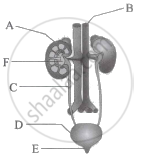
Identify the labels (A-F) in the given diagram of excretory system in human beings.
The filtration units of kidneys are called ____________.
Read the following terms given below.
| root hairs | xylem | urethra |
| arteries | kidneys | veins |
| atria | capillaries | heart |
| ureter | phloem | urinary bladder |
Group the terms on the basis of the categories given below.
- Circulatory system of animals.
- Excretory system in human.
- Transport of substances in plants.
Structural unit of kidneys are ______.
Where does the selective reabsorption of Glomerular filtrate take place?
