Advertisements
Advertisements
Question
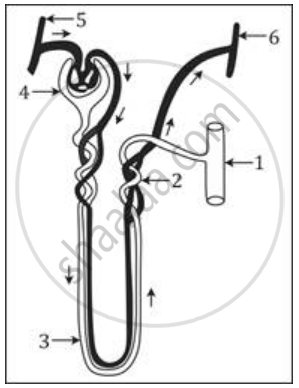
Identify the wrong match
Options
Bowman’s capsule - Glomerular filteration
DCT - Absorption of glucose
Henle’s loop - Concentration of urine
PCT - Absorption of Na+ and K+ ions
Advertisements
Solution
DCT - Absorption of glucose
RELATED QUESTIONS
Why is excretion necessary? Name the common excretory substance in our body.
Choose the correct answer:
Uric acid is excreted by _______________
Choose the odd one out in the following serie:
Urea, uric acid, haemoglobin.
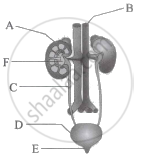
Given below is the figure of certain organs and associated parts in the human body. Study the same and answer the question that follow:
Name the two major steps involved in the formation of the fluid that passes down the part labeled '3'.

Explain the Term: Tubular reabsorption
Name the Following
The organ in which urine is stored before its elimination.
Give Technical Term:
Name the organ in which urine is stored before its elimination from the body.
The functional unit of kidney is ______.
Name the three filtration barriers that solutes must come across as they move from plasma to the lumen of Bowman’s capsule. What components of the blood are usually excluded by these layers?
If a person's urine report shows the presence of proteins, it indicates ______.
Urethra is a passage from which urine is ____________.
Match the parts of the nephron in column I with their function in column II.
| Column I | Column II | ||
| (a) | Loop of Henle | (i) | Ultrafiltration |
| (b) | Proximal convoluted tubule | (ii) | Secretion of hydrogen ions |
| (c) | Distal convoluted tubule | (iii) | Reabsorption of glucose |
| (d) | Bowman's capsule | (iv) | Concentration of urine |
The kidneys are made up of millions of excretory units called ______.
Which one of the following statements is INCORRECT?
Match the terms given in Column I with their physiological processes given in Column II and choose the correct answer
| Column I | Column II |
| A. Proximal convoluted tubule | i. Formation of concentrated urine |
| B. Distal convoluted tubule | ii. Filtration of blood |
| C. Henle's loop | iii. Reabsorption of 70 - 80% of electrolytes |
| D. Counter-current mechanism | iv. Ionic balance |
| E. Renal corpuscle | v. Maintenance of concentration gradient in medulla |
The following abbreviations are used in the context of excretory functions, what do they stand for?
DCT
Match Column I with Column II.
| Column I | Column II |
| A. PCT | (i) Concentrated urine formation |
| B. DCT | (ii) Filtration of blood |
| C. Loop of Henle | (iii) Reabsorption of 70-80% of the electrolyte |
| D. Counter current mechanism | (iv) Ionic balance |
| E. Renal corpuscle | (v) Maintenance of concentration gradient in medulla |
Select the correct option from the codes given below.
The inner visceral layer of glomerular capsule composed of specialised cells called ______.
Kidneys are vital organs for survival. Several factors like infections, injury or restricted blood flow to kidneys reduce the activity of kidneys. This leads to the accumulation of poisonous wastes in the body, which can even lead to death. In case of kidney failure, an artificial kidney can be used. An artificial kidney is a device to remove waste products from the blood through dialysis.
i. a. Name the artery that brings oxygenated blood to the kidney.
b. Name the cluster of the thin-walled blood capillaries present in the Bowman's capsule.
ii. In the human excretory system, name the organ which stores urine. Is this organ under hormonal control or nervous control?
iii. List two major steps involved in the formation of urine and state in brief their functions.
OR
iii. In which part of the nephron does selective reabsorption take place? List the factors which the amount of water reabsorbed depends on.
Choose the odd one out in the following set and write the category for the remaining terms: