Advertisements
Advertisements
Question
State if the following statement is true or false. Correct the statement if it is false.
Each kidney contains millions of microscopic filtering units called ureters.
Options
True
False
Advertisements
Solution
False.
Correct: Each kidney contains millions of microscopic filtering units called nephrons.
APPEARS IN
RELATED QUESTIONS
Name the following:
A chordate animal having flame cells as excretory structures
The diagram given below represents an organ system in the human body. Study the same and answer the questions that follow :
Name the structural and functional units of the part marked 1.
Choose the correct answer:
Presence of RBCs in urine is called _____________
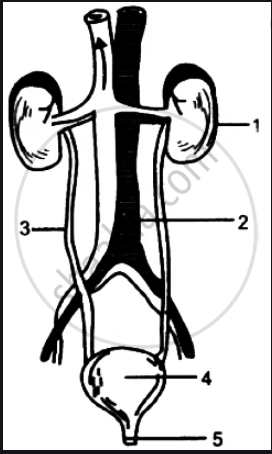
Given below is the figure of certain organs and associated parts in the human body. Study the same and answer the question that follow:
Name the parts numbered 1 to 5.
Name the Following
The organ in which urine is stored before its elimination.
Complete the following sentence with appropriate words:
Sweat formed in the sweat glands passes into the sweat duct which opens to the outside at the surface of the skin by means of ______.
Choose the Odd One Out:
Choose the correct option.
The yellow colour of the urine is due to presence of ________.
______ is sac–like in shape.
The following abbreviations are used in the context of excretory functions, what do they stand for?
DCT
