Advertisements
Advertisements
Question
The following abbreviations are used in the context of excretory functions, what do they stand for?
DCT
Advertisements
Solution
DCT – Distal Convoluted Tubule
APPEARS IN
RELATED QUESTIONS
Name the following:
Cortical portions projecting between the medullary pyramids in the human kidney.
Define the following:
Excretion
Tick the most appropriate answer.
The opening of the urinary bladder is called
Fill in the blank.
Urine contains .................... and ................. as nitrogenous waste.
Look at the figure given below. It is a section of human kidney as seen from the front.
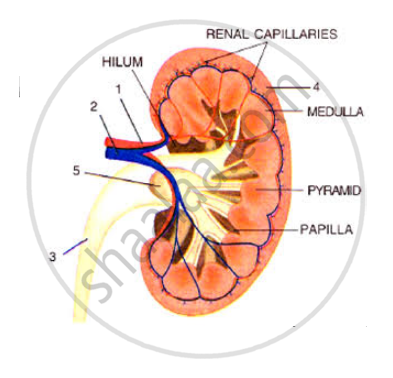
Name the parts numbered 1-5.
Give Technical Term:
The nitrogenous wastes produced in man.
Give Technical Term:
The waste product which is excreted by the liver.
Mention, if the following statement is True or False. If false rewrite the wrong statement in its correct form:
Urine leaves the urinary bladder of a female by means of the uterus.
Write the functional activity of the following structure: Urethra
Choose the Odd One Out:
Choose the correct option.
Urea is a product of breakdown of ______.
How many kidneys do we have?
Identify the CORRECT statement with reference to nephron.
Identify the CORRECT statement.
In the process of urine formation, the maximum amount of water from the glomerular filtrate is reabsorbed in the ______.
Thin muscular tubes carry urine from the kidney to the urinary bladder.
The counter-current mechanism operates in nephron ______.
Statement I: In the nephron, the descending limb of loop of Henle is impermeable to water and permeable to electrolytes.
Statement II: The proximal convoluted tubule is lined by simple columnar brush border epithelium and increases the surface area for reabsorption.
In the light of the above statements, choose the correct answer from the options given below:
An organ with sphincters at its origin is ______.
