Advertisements
Advertisements
Question
Name the following:
Cortical portions projecting between the medullary pyramids in the human kidney.
Advertisements
Solution
Columns of Bertini
APPEARS IN
RELATED QUESTIONS
Name the blood vessel that brings blood to the kidneys.
One of Harry’s organs is not functioning properly. There is extra fluid build up in his body causing swelling in his ankles and feet.
What should Harry do? Tick the correct answer.
He should see a
The diagram given below represents an organ system in the human body. Study the same and answer the questions that follow :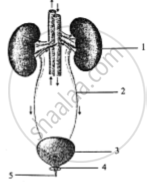
What is the fluid that accumulates in part 3?
Which is the main nitrogenous waste present in it?
Draw and label the diagram.
Human excretory system
Choose the correct answer:
Presence of RBCs in urine is called _____________
Name the following:
Animals which excrete uric acid.
Differentiate between:
Excretion and Egestion
Explain the Term: Urinary bladder
Complete the following sentence with appropriate words:
Sweat formed in the sweat glands passes into the sweat duct which opens to the outside at the surface of the skin by means of ______.
Write the functional activity of the following structure: Bladder
Choose the Odd One Out:
Choose the correct option.
Urea is a product of breakdown of ______.
Differentiate protonephridia from metanephridia.
Differentiate cortical from medullary nephrons.
The human kidneys are located on either side of the vertebral column at the level of ______.
The function of PCT of the kidney is ______.
The functional units of the kidney are called ______.
The loop of Henle lies in ______.
Match Column I with Column II.
| Column I | Column II |
| A. PCT | (i) Concentrated urine formation |
| B. DCT | (ii) Filtration of blood |
| C. Loop of Henle | (iii) Reabsorption of 70-80% of the electrolyte |
| D. Counter current mechanism | (iv) Ionic balance |
| E. Renal corpuscle | (v) Maintenance of concentration gradient in medulla |
Select the correct option from the codes given below.
Give two examples of the following:
Accessory excretory organs
