Advertisements
Advertisements
Question
Differentiate cortical from medullary nephrons.
Advertisements
Solution
| Sr. No. | Cortical nephrons | Medullary nephrons |
| 1. | These are found in the cortex. | These are found in the medulla. |
| 2. | These have short Henle’s loop. | These have long Henle’s loop. |
RELATED QUESTIONS
State if the following statement is true or false. Correct the statement if it is false.
Each kidney contains millions of microscopic filtering units called ureters.
Differentiate between
ureter and urethra.
The diagram given below represents an organ system in the human body. Study the same and answer the questions that follow :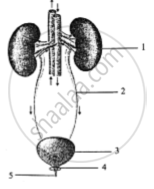
What is the fluid that accumulates in part 3?
Which is the main nitrogenous waste present in it?
Choose the correct answer:
Orinithin cycle operates in ________
Draw a neat and well labeled diagram of human excretory system.
Write the functional activity of the following structure:
Urethra
Give Reasons for the Following:
All living things must excrete.
Draw a well-labeled diagram of the human excretory system.
What are some common excretory product?
Mention, if the following statement is True or False. If false rewrite the wrong statement in its correct form:
Ammonia is converted into urea in kidney.
The point where the ureter arises from the kidney to where it opens into the urinary bladder is about ____________ cm.
Identify the structures present in the cortex of the kidney.
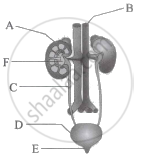
Identify the labels (A-F) in the given diagram of excretory system in human beings.
The filtration units of kidneys are called ____________.
Choose the correct path of urine in our body
Describe the process of urine formation in kidneys.
Show the structure of a renal corpuscle with the help of a diagram.
In between the two adjacent renal pyramids, ..A ... is present. Identify A
Write full form of the following abbreviation:
PCT
