Advertisements
Advertisements
Question
The following abbreviations are used in the context of excretory functions, what do they stand for?
GFR
Advertisements
Solution
GFR – Glomerular Filtration Rate
APPEARS IN
RELATED QUESTIONS
Match the items of column I with those of column II:
| Column I | Column II | ||
| (a) | Ammonotelism | (i) | Birds |
| (b) | Bowman’s capsule | (ii) | Bowman’s capsule |
| (c) | Micturition | (iii) | Bony fish |
| (d) | Uricotelism | (iv) | Urinary bladder |
| (e) | ADH | (v) | Renal tubule |
State if the following statement is true or false. Correct the statement if it is false.
The organs that help our body to get rid of the waste are called respiratory organs.
Choose the correct answer:
Orinithin cycle operates in ________
The given diagram represents a nephron and its blood supply. Study the diagram and answer the following question :
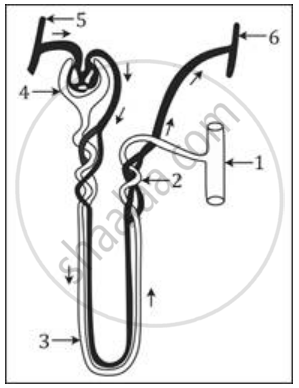
State the reason for the high hydrostatic pressure in the glomerulus.
Describe about physical properties of urine
Why excretion is necessary?
Give Reasons for the Following:
It is necessary to maintain a normal osmotic concentration of blood
Name the Following
The act of passing urine.
Complete the following sentence with appropriate word:
Automatic self-regulation of salt and water within the body is known of ______.
Choose the correct option.
Person suffering from kidney stone is advised not to have tomatoes as it has _______.
The process by which the body removes waste is ______.
Differentiate cortical from medullary nephrons.
Both PCT and DCT lie in the ______
Identify the labels (a, b, c, d) in the given diagram of the Malpighian corpuscle and choose the correct option.
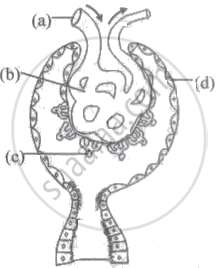
The glomerular capillaries filter out its contents due to ____________.
Match the parts of the nephron in column I with their function in column II.
| Column I | Column II | ||
| (a) | Loop of Henle | (i) | Ultrafiltration |
| (b) | Proximal convoluted tubule | (ii) | Secretion of hydrogen ions |
| (c) | Distal convoluted tubule | (iii) | Reabsorption of glucose |
| (d) | Bowman's capsule | (iv) | Concentration of urine |
Analogy:
Neurons: Nervous system.
Nephrons: ______.
Describe the process of urine formation in kidneys.
Kidneys are reddish brown and
Match Column I with Column II.
| Column I | Column II |
| A. PCT | (i) Concentrated urine formation |
| B. DCT | (ii) Filtration of blood |
| C. Loop of Henle | (iii) Reabsorption of 70-80% of the electrolyte |
| D. Counter current mechanism | (iv) Ionic balance |
| E. Renal corpuscle | (v) Maintenance of concentration gradient in medulla |
Select the correct option from the codes given below.
