Advertisements
Advertisements
प्रश्न
Differentiate cortical from medullary nephrons.
Advertisements
उत्तर
| Sr. No. | Cortical nephrons | Medullary nephrons |
| 1. | These are found in the cortex. | These are found in the medulla. |
| 2. | These have short Henle’s loop. | These have long Henle’s loop. |
संबंधित प्रश्न
Ascending limb of Henle’s loop is ______ to water, whereas the descending limb is ______to it.
Choose the correct answer:
Presence of RBCs in urine is called _____________
Look at the figure given below. It is a section of human kidney as seen from the front.
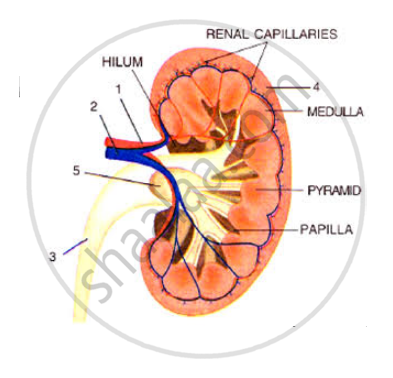
Name the parts numbered 1-5.
The given diagram represents a nephron and its blood supply. Study the diagram and answer the following question :
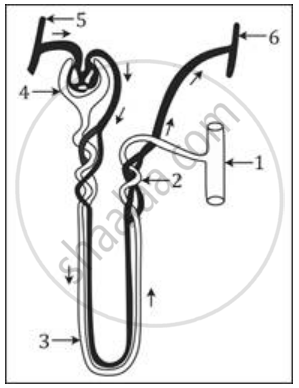
State the reason for the high hydrostatic pressure in the glomerulus.
The given diagram represents a nephron and its blood supply. Study the diagram and answer the following question :
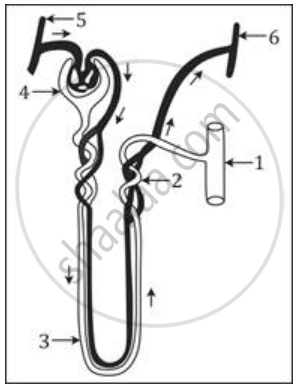
Name the part of the nephron which lies in the renal medulla.
Differentiate between:
Excretion and Egestion
Name the Following
The gas excreted by the lungs.
What are some common excretory product?
Write the functional activity of the following structure: Iliac artery
Column 2 is a list of items related to ideas in Column 1. Match the term in Column 2 with the suitable idea given in Column 1.
| Column 1 | Column 2 | ||
| i | Liver | a | basic unit of the brain |
| ii | Ova | b | stimulated by light |
| iii | Alveoli | c | deoxygenated blood |
| iv | Cochlea | d | part of the sclera |
| v | Vein | e | haploid cell |
| vi | Neuron | f | blind sacs |
| vii | Stomata | g | found in the kidney |
| viii | Grana | h | audio receptors |
| i | diffusion of gases | ||
| j | breakdown of proteins | ||
| k | diploid cell | ||
Identify the labels (A-F) in the given diagram of excretory system in human beings.
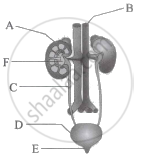
Urethra is a passage from which urine is ____________.
Where is the dirty blood in our body filtered?
______ is sac–like in shape.
What is the contribution of Joseph E. Murray to Nephrology?
Rearrange the jumbled words and fill in the blanks in the following passage to make it a meaningful description.
The human urinary system consists of a pair of ______ ( nyedik), which form the urine; a pair of ______ (ertreu), which conduct the ______ (neuri) from kidneys to the ______ (naryuri drebdal) for storage of urine and a ______ (reuhrat) through which the urine is voided by bladder contractions.
Structural unit of kidneys are ______.
Give two examples of the following:
Accessory excretory organs
Complete the following analogy.
Parietal wall of Bowman’s capsule : squamous epithelium : : PCT : ______ epithelium.
