Advertisements
Advertisements
प्रश्न
Match the items of column I with those of column II:
| Column I | Column II | ||
| (a) | Ammonotelism | (i) | Birds |
| (b) | Bowman’s capsule | (ii) | Bowman’s capsule |
| (c) | Micturition | (iii) | Bony fish |
| (d) | Uricotelism | (iv) | Urinary bladder |
| (e) | ADH | (v) | Renal tubule |
Advertisements
उत्तर
| Column I | Column II | ||
| (a) | Ammonotelism | (iii) | Bony fish |
| (b) | Bowman’s capsule | (v) | Renal tubule |
| (c) | Micturition | (iv) | Urinary bladder |
| (d) | Uricotelism | (i) | Birds |
| (e) | ADH | (ii) | Water reabsorptio |
APPEARS IN
संबंधित प्रश्न
Name the following:
A loop of capillary running parallel to the Henle’s loop
Tick the most appropriate answer.
The opening of the urinary bladder is called
Tick the most appropriate answer.
The Bowman’s capsule and glomerulus together form the
Fill in the blank.
.................. carries urine from the kidney to the urinary bladder.
Differentiate between
ureter and urethra.
Answer the following in detail.
Write a short note on artificial kidneys.
The diagram given below represents an organ system in the human body. Study the same and answer the questions that follow :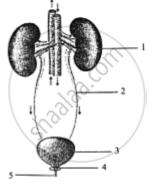
Label the parts marked 2 and 4. Mention the function of part 5.
Name the following:
Organ which produces urea.
Look at the figure given below. It is a section of human kidney as seen from the front.
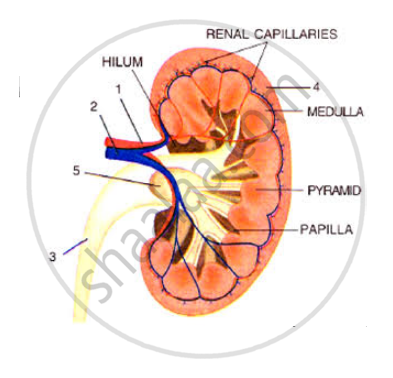
Name the parts numbered 1-5.
Given below is the figure of certain organs and associated parts in the human body. Study the same and answer the question that follow:
Name the two major steps involved in the formation of the fluid that passes down the part labeled '3'.

Give a simple definition of excretion.
Name the Following
A process by which the unwanted nitrogenous wastes are eliminated from the body.
Name the Following
Thin membranous sac serving as the reservoir of urine.
Mention, if the following statement is True or False. If false rewrite the wrong statement in its correct form:
Urethra carries urine from the kidney to the urinary bladder.
Write the functional activity of the following structure: Iliac vein
Choose the correct option.
The snakes living in desert are mainly ______.
Identify the CORRECT statement with respect to blood vessels associated with the kidney.
The functional units of the kidney are called ______.
The loop of Henle lies in ______.
Select the substances given below that need to be excreted from the body, (urea, amino acids, carbon dioxide, uric acid, glucose)
