Advertisements
Advertisements
प्रश्न
Name the following:
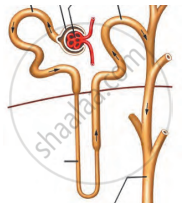
A loop of capillary running parallel to the Henle’s loop
Advertisements
उत्तर
Vasa recta
APPEARS IN
संबंधित प्रश्न
Protein-free fluid is filtered from blood plasma into the Bowman’s capsule.
Name the following:
A chordate animal having flame cells as excretory structures
Excretion primarily involves
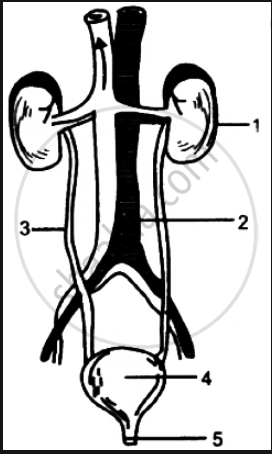
Given below is the figure of certain organs and associated parts in the human body. Study the same and answer the question that follow:
Name the two main organic constituents of the fluid that flows down the part labeled '3'.
What kind of urine (concentration) is produced in the human body?
Why urine is acidic while blood is alkaline?
Explain the Term: Ureotelism
Give Technical Term:
Name the organ in which urine is stored before its elimination from the body.
Complete the following sentence with appropriate words:
Sweat formed in the sweat glands passes into the sweat duct which opens to the outside at the surface of the skin by means of ______.
State the Location:
Kidneys
Complete the diagram/chart with correct labels/ information. Write the conceptual details regarding it.
Identify the biological term
Removal of unwanted substances from the body.
Match the parts given in Column I with their physiological processes given in Column II.
| Column I | Column II | ||
| i. | Proximal convoluted tubule | a. | Formation of concentrated urine |
| ii. | Distal convoluted tubule | b. | Filtration of blood |
| iii. | Henle's loop | c. | Reabsorption of 70-80% of electrolytes |
| iv. | Vasa recta | d. | Ionic balance |
| v. | Malpighian body | e. | Counter mechanism |
Where does facultative reabsorption of sodium ions and water take place?
Match the parts of the nephron in column I with their function in column II.
| Column I | Column II | ||
| (a) | Loop of Henle | (i) | Ultrafiltration |
| (b) | Proximal convoluted tubule | (ii) | Secretion of hydrogen ions |
| (c) | Distal convoluted tubule | (iii) | Reabsorption of glucose |
| (d) | Bowman's capsule | (iv) | Concentration of urine |
The loop of Henle lies in ______.
The following abbreviations are used in the context of excretory functions, what do they stand for?
GFR
Arrange and rewrite the terms in group in correct order to be in a logical sequence, beginning with the term that is underlined:
Loop of Henle, Distal convoluted tubule, Bowman's Capsule, Proximal convoluted tubule.
Urethral external sphincter present between urinary bladder and urethra is made up of ______ muscles, and is ______ in nature.
