Advertisements
Advertisements
प्रश्न
Henle’s loop plays an important role in concentrating the urine.
विकल्प
True
False
Advertisements
उत्तर
This statement is True.
Explanation:
Henle’s loop, specifically its descending and ascending limbs, plays a crucial role in concentrating urine by creating a gradient in the kidney medulla. This process allows for the reabsorption of water and solutes, leading to more concentrated urine.
APPEARS IN
संबंधित प्रश्न
Answer the following in detail.
Draw a labelled diagram of the urinary system in human beings and describe each part.
Answer the following in detail.
How do skin and lungs help in excretion?
Write down the functional activity of the following parts,
Glomerulus …………………
Differentiate between the following pairs of term :
Excretion and katabolism
The given diagram represents a nephron and its blood supply. Study the diagram and answer the following question :
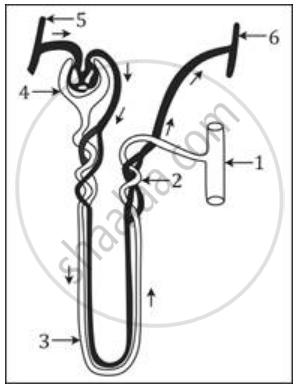
Name the blood vessel which contains the least amount of urea in this diagram.
Name the Following
The act of passing urine.
Give Technical Terms:
What are the organic constituents of normal human urine?
Complete the following sentence with appropriate word:
The human liver converts ammonia into ______
Mention, if the following statement is True or False. If false rewrite the wrong statement in its correct form:
Harmful ammonium compounds formed during the metabolism in the cells are broken down to form urea in the kidney.
Multiple Choice Question: Profuse sweating take place during heavy muscular exercise. The reason is:
Choose the correct option.
Volume of the urine is regulated by ______.
Differentiate the following.
Excretion and Secretion
Name the three filtration barriers that solutes must come across as they move from plasma to the lumen of Bowman’s capsule. What components of the blood are usually excluded by these layers?
Identify the wrong match
Identify the labels (a, b, c, d) in the given diagram of the Malpighian corpuscle and choose the correct option.
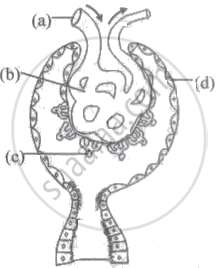
The left side of the heart receives oxygenated blood from ______.
The kidneys are made up of millions of excretory units called ______.
Arrange and rewrite the term in the group in the correct order so as to be in a logical sequence, beginning with the term that is underlined.
Lungs, Right auricle, Inferior venacava, Pulmonary Artery.
Name the following:
Three main parts of our urinary system.
Choose the odd one out in the following set and write the category for the remaining term:
Kidney, ureter, neuron, urethra, urinary bladder
