Advertisements
Advertisements
प्रश्न
Identify the biological term
Removal of unwanted substances from the body.
विकल्प
Excretion
glomerulus
urinary bladder
glomerular filtrate
ureters
urine
Bowman’s capsule
urinary system
reabsorption
micturition
osmosis
proteins
Advertisements
उत्तर
Excretion
संबंधित प्रश्न
Define excretion. Write the four organs of the human urinary system in their correct sequence.
State if the following statement is true or false. Correct the statement if it is false.
Each kidney contains millions of microscopic filtering units called ureters.
Find the odd one out. Give a reason for your choice.
skin, heart, lung, liver, kidney
One of the following sets of body parts or substances or processed, pick out the one item which overall includes the remaining foir.
Glomerular filtrate, bowman’s capsule, ultrafiltration, glomerulus, blood plasma.
Draw and label the diagram.
Human excretory system
Given below is the figure of certain organs and associated parts in the human body. Study the same and answer the question that follow:
Name the two main organic constituents of the fluid that flows down the part labeled '3'.
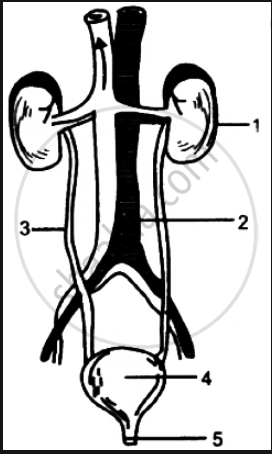
With the help of a labelled diagram describe human excretory system.
How will you identify acute kidney injury by urine analysis?
How is urea produced?
Urine is formed from alkaline blood, but it is acidic in nature”. Comment.
Explain the Term: Loop of Henle
Explain the Term: Ureotelism
Give Technical Term:
The nitrogenous wastes produced in man.
Which one of the following substance is not a constituent of sweat?
The capillaries of the glomerulus reunite to form _______ which leaves the Bowman's capsule.
Identify the labels (a, b, c, d) in the given diagram of the Malpighian corpuscle and choose the correct option.
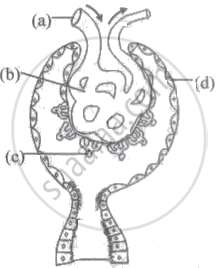
The functional units of the kidney are called ______.
The muscular tube through which stored urine is passed out of the body is called –
The following abbreviations are used in the context of excretory functions, what do they stand for?
DCT
Match Column I with Column II.
| Column I | Column II |
| A. PCT | (i) Concentrated urine formation |
| B. DCT | (ii) Filtration of blood |
| C. Loop of Henle | (iii) Reabsorption of 70-80% of the electrolyte |
| D. Counter current mechanism | (iv) Ionic balance |
| E. Renal corpuscle | (v) Maintenance of concentration gradient in medulla |
Select the correct option from the codes given below.
Arrange and rewrite the term in the group in the correct order so as to be in a logical sequence, beginning with the term that is underlined.
Lungs, Right auricle, Inferior venacava, Pulmonary Artery.
