Advertisements
Advertisements
Question
Differentiate between
ureter and urethra.
Advertisements
Solution
| Ureter | Urethra | ||
| 1 | It is a tube that leads out of each kidney. | 1 | It is a canal-like opening at the bottom of the urinary bladder. |
| 2 | These tubes carry urine from the kidneys of the urinary bladder. | 2 | This opening excretes urine out of the body. |
| 3 | There are two ureters. | 3 | There is only one urethra. |
APPEARS IN
RELATED QUESTIONS
Define the following:
Excretion
The diagram given alongside represents an organ system in the human body. Study the same and answer the questions that follow:
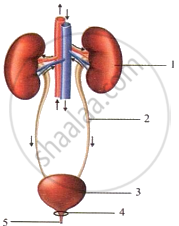
- Identify the system
- Label the parts marked 2 and 4. Mention the function of part 5.
- Name the structural and functional units of the part marked 1.
- What is the fluid that accumulates in part 3?
Which is the main nitrogenous waste present in it? - Draw a neat, labelled diagram showing the longitudinal section of part 1.
Give Technical Term:
Name the organ in which urine is stored before its elimination from the body.
Complete the following sentence with appropriate words:
Sweat formed in the sweat glands passes into the sweat duct which opens to the outside at the surface of the skin by means of ______.
The functional unit of kidney is ______.
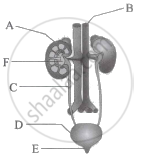
Identify the labels (A-F) in the given diagram of excretory system in human beings.
Which is reabsorbed in selective reabsoiption?
The collecting tubule of the kidney is important as it helps in ______.
The function of PCT of the kidney is ______.
The following abbreviations are used in the context of excretory functions, what do they stand for?
GFR
