Advertisements
Advertisements
Question
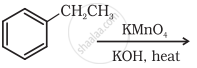
Show how the following compound can be converted to benzoic acid.
Bromobenzene
Advertisements
Solution

APPEARS IN
RELATED QUESTIONS
On acid hydrolysis, propane nitrile gives.
How is carbolic acid prepared from chlorobenzene?
Write the structures of A and B in the following reactions

Predict the products of the following reactions:

Show how the following compound can be converted to benzoic acid.
Ethylbenzene
Complete the synthesis by giving missing starting material, reagent or product.
How is methoxy benzene prepared from carbolic acid?
What is the action of following reagents on glucose?
1. Bromine water
2. Hydroxylamine
The functional group present in triacylglycerol is _______.
Assertion: Aldehydes and ketones, both react with Tollen’s reagent to form silver mirror.
Reason: Both, aldehydes and ketones contain a carbonyl group.
Substitution of one alkyl group by replacing hydrogen of primary amines
Which of the following substance produced acetaldehyde on dry distillation?
Benzoic acid can be obtained by the oxidation of all of the following EXCEPT ______.
Match List - I with List - II.
| List - I | List - II | ||
| (a) |  \[\ce{->[CO,HCl][Anhyd. AlCl3/CuCl]}\] \[\ce{->[CO,HCl][Anhyd. AlCl3/CuCl]}\] |
(i) | Hell-Volhard-Zelinsky reaction |
| (b) |
\[\begin{array}{cc}
\ce{O}\phantom{.................}\\ ||\phantom{.................}\\ \ce{R - C - CH3 + NaOX ->} \end{array}\] |
(ii) | Gattermann-Koch reaction |
| (c) | \[\ce{R - CH2 - OH + R'COOH ->[Conc. H2SO4]}\] | (iii) | Haloform reaction |
| (d) | \[\ce{R - CH2COOH ->[(i) X2/Red P][(ii) H2O]}\] | (iv) | Esterification |
Choose the correct answer from the options given below.
Fill in the blanks by choosing the appropriate words from those given in the brackets:
[stable, low, aldehyde, unstable, 6, 4, ethane, Clemmensen’s, 2, 3, carboxylic acid, high, propane, Rosenmund's]
The primary alcohols are easily oxidised first into ______ and then into ______.
