Advertisements
Advertisements
Question
Right or wrong sentence.
The K and L shells of the elements Na and Mg contain electrons.
Options
Right
Wrong
Advertisements
Solution
The given sentence is right.
Explanation:
- Both sodium (Na) and magnesium (Mg) have electrons in their K and L shells; specifically, their K shells are filled with 2 electrons and their L shells are filled with 8 electrons.
- While they also have electrons in their M shells (1 and 2, respectively), it is factually accurate to state that the K and L shells contain electrons.
APPEARS IN
RELATED QUESTIONS
Nitrogen (atomic number 7) and phosphorus (atomic number 15) belong to group 15 of the Periodic Table. Write the electronic configuration of these two elements. Which of these will be more electronegative? Why?
Write the names given to the vertical columns and horizontal rows in the Modern Periodic Table. How does the metallic character of elements vary on moving down a vertical column? How does the size of atomic radius vary on moving left to right in a horizontal row? Give reason in support of your answer in the above two cases.
How many rows and columns are there in the modern periodic table?
Write the merits of the modern periodic table over Mendeleev’s Periodic table
Give two example of group 1 elements.
Give two example of group 18 elements.
How were the positions of isotopes of an element decided in the modern periodic table?
The three elements having chemical symbols of Si, B and Ge are:
(a) all metals
(b) all non-metals
(c) all metalloids
(d) Si is metalloid, B is metal and Ge is non-metal
State whether the following statement is true or false:
On going down in a group of the periodic table, the number of valence electrons increases.
The elements A, B, C and D belong to groups 1, 2, 14 and 17 respectively of the periodic table. Which of the following pairs of elements would produce a covalent bond?
(i) A and D
(ii) C and D
(iii) A and B
(iv) B and C
(v) A and C
State the term
The tabular arrangement of elements in horizontal rows and vertical columns _________
Name the type of elements which have outermost shell incomplete.
Fill in the blank:
The horizontal rows in the periodic table are called _____________.
How many periods and groups are there in the modern periodic table?
What is meant in the periodic table by a period?
Name an element of group 18 which can form compounds.
Define the atomic size.
Give the symbol and valency of the following element and radical.
Magnesium
Give the symbol and valency of the following element and radical.
Nitrate
Name the following:
The group of the Modern Periodic Table to which calcium [Ca2+] belongs.
State the number of elements in Period 3 of the Periodic Table.
Find the correlation:
Mendeleev’s periodic table : atomic mass : : Modern periodic table : _______
Right or wrong sentence.
To the left of the zig-zag line in the periodic table are the metal elements.
In the modern periodic table, the positions of 1 to 20 elements are shown here. Identify the elements A and B. Write their atomic number.
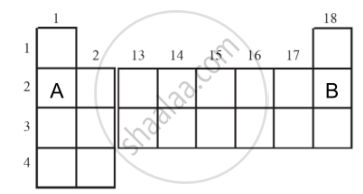
Explain structure of modern periodic table in short.
Which of these belong to the same period?
| Element | A | B | C |
| Atomic number | 2 | 10 | 5 |
The elements A, B, C, D and E have atomic number 9, 11, 17, 12 and 13 respectively. Which pair of elements belong to the same group?
Where would you locate the element with electronic configuration 2,8 in the Modern Periodic Table?
The element with atomic number 14 is hard and forms acidic oxide and a covalent halide. To which of the following categories does the element belong?
Three elements A, B and C have 3, 4 and 2 electrons respectively in their outermost shell. Give the group number to which they belong in the Modern Periodic Table. Also, give their valencies.
Choose an element from period 3 of modern periodic table that matches the description given below in instance. Give a reason for your choice.
It has a similar structure to diamond.
Group 16 elements are collectively called as ______.
A part of modern periodic table is given below. On its basis, answer the following questions:
| Group No. → | 1 | 2 | 13 | 14 | 15 | 16 | 17 | 18 |
| Period ↓ | ||||||||
| 2 | A | B | ||||||
| 3 | E | D | F | C |
Write the molecular formula of the compound formed by the combination:
E and B
Explain giving reason why although the nuclear charge in atoms increases in moving from left to right in a period as well as in moving from top to bottom in a group in the Modern periodic table, but the size of the atoms does not vary similarly in both situations.
Name the non-metals in the first twenty elements.
Answer the following in respect of element \[\ce{_16^32S}\].
To which group and period does it belong?
A group of elements in the periodic table is given below (Boron is the first member of the group and Thallium is the last).
Boron, Aluminium, Gallium, Indium, Thallium
Answer the following question in relation to the above group of elements:
If the electronic configuration of aluminium is 2, 8, 3, how many electrons are there in the outer shell of thallium?
