Advertisements
Advertisements
प्रश्न
Right or wrong sentence.
The K and L shells of the elements Na and Mg contain electrons.
विकल्प
Right
Wrong
Advertisements
उत्तर
The given sentence is right.
Explanation:
- Both sodium (Na) and magnesium (Mg) have electrons in their K and L shells; specifically, their K shells are filled with 2 electrons and their L shells are filled with 8 electrons.
- While they also have electrons in their M shells (1 and 2, respectively), it is factually accurate to state that the K and L shells contain electrons.
APPEARS IN
संबंधित प्रश्न
The position of three elements A, B and C in the Periodic Table are shown below –
|
Group 16
|
Group 17
|
|
−
|
−
|
|
−
|
A
|
|
−
|
−
|
|
B
|
C
|
(a) State whether A is a metal or non-metal.
(b) State whether C is more reactive or less reactive than A.
(c) Will C be larger or smaller in size than B?
(d) Which type of ion, cation or anion, will be formed by element A?
Nitrogen (atomic number 7) and phosphorus (atomic number 15) belong to group 15 of the Periodic Table. Write the electronic configuration of these two elements. Which of these will be more electronegative? Why?
How does the tendency of elements to gain electrons change as we move from left to right in a period? State the reason of this change.
Write the merits of the modern periodic table over Mendeleev’s Periodic table
How were the positions of cobalt and nickel resolved in the modern periodic table?
where should hydrogen be placed in the modern periodic table? Give reason for your answer.
Which of the following statement about the modern periodic table is correct?
(a) It has 18 horizontal rows known as periods.
(b) It has 7 vertical columns known as periods.
(c) It has 18 vertical columns known as groups.
(d) It has 7 horizontal rows known as groups.
Consider the following elements:
Na, Ca, Al, K, Mg, Li
Which of these elements belong to the same period of the periodic table?
Consider the following elements:
Ca, Cl, Na, I, Li, Ba, Sr, K, Br
Separate these elements into three groups (families) of similar properties. State one property in each case on the basis of which you have made your choice.
How would the tendency to gain electrons change on moving from left to right in a period of the periodic table?
State whether the following statement is true or false:
On going down in a group of the periodic table, the number of valence electrons increases.
State how the valency of elements varies in a period of the periodic table?
On the basis of electronic configuration, how will you identify the first element of a period?
What is the main characteristic of the last elements in the periods of the periodic table? What is the general name of such elements?
In the modern Periodic Table, why does cobalt with higher atomic mass of 58.93 appear before nickel having lower atomic mass of 58.71?
Which of the following are the correct characteristics of isotopes of an element?
(i) same atomic mass
(ii) same atomic number
(iii) same physical properties
(iv) same chemical properties
(a) (i), (ii) and (iv)
(b) (ii), (iii) and (iv)
(c) (ii) and (iii)
(d) (ii) and (iv)
Name the scientist who stated the modern periodic law.
Correct the statement.
Copper and zinc are representative elements.
Name two elements in each case:
Transition element
Name the type of elements which have outermost shell complete.
Name the type of elements which have outermost shell incomplete.
Answer the following in respect of element `31/15 P`
Give its electronic configuration
Name an alkali metal in period 3 and halogen in period 2.
Give the symbol and valency of the following element and radical.
Sulphite
Give the chemical formula of sodium sulphite
State the number of elements in Period 1 of the Periodic Table.
The groups 1 and 2 constitute the ______ block.
Write an explanation.
Period
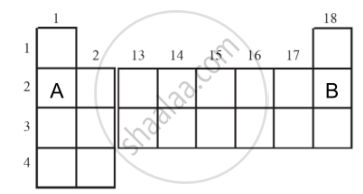
In the modern periodic table, the positions of 1 to 20 elements are shown here. Identify the elements A and B. Write their atomic number.
What is the symbol of the element Tungsten?
Where would you locate the element with electronic configuration 2,8 in the Modern Periodic Table?
An element which is an essential constituent of all organic compounds belongs to
Which of the following elements does not lose an electron easily?
Spot the error:
The elements of group 13 are called the carbon family.
- Write the electronic configuration of element X, given by its symbol as under: \[\ce{^40_20 X}\]
- Determine its position in the modem periodic table.
- What is the nature of its oxide?
- Name one other element of its group.
Explain giving reason why although the nuclear charge in atoms increases in moving from left to right in a period as well as in moving from top to bottom in a group in the Modern periodic table, but the size of the atoms does not vary similarly in both situations.
Define groups of modern periodic table.
Answer the following in respect of element \[\ce{_16^32S}\].
To which group and period does it belong?
