Advertisements
Advertisements
प्रश्न
The groups 1 and 2 constitute the ______ block.
विकल्प
s
p
d
d
Advertisements
उत्तर
The groups 1 and 2 constitute the s block.
Explanation:
The Modern Periodic Table is divided into blocks based on which orbital the valence electrons enter. Groups 1 and 2 are called the s-block because their outermost electrons enter the $ns$ orbital.
APPEARS IN
संबंधित प्रश्न
Fill in the following blank with suitable word:
The basis for modern periodic table is ...............
How were the positions of isotopes of an element decided in the modern periodic table?
The three elements having chemical symbols of Si, B and Ge are:
(a) all metals
(b) all non-metals
(c) all metalloids
(d) Si is metalloid, B is metal and Ge is non-metal
Which of the following statement is correct in regard to the classification of elements?
(a) Elements in modern periodic table are arranged on the basis of increasing atomic masses.
(b) Elements in Mendeleev's periodic table are arranged on the basis of increasing atomic numbers.
(c) In modern periodic table, the element nickel of lower atomic mass is kept before the element cobalt of higher atomic mass.
(d) In modern periodic table, the isotopes of chlorine having different atomic masses are kept in the same group.
The atomic particle whose number in the atoms of an element always remains the same and which forms the real basis for the modern classification of elements is:
(a) electron
(b) proton
(c) neutron
(d) meson
Consider the following elements:
Na, Ca, Al, K, Mg, Li
Which of these elements belong to the same period of the periodic table?
How does the chemical reactivity of the halogens vary on going in group 17 of the periodic table?
State whether the following statement is true or false:
On going down in a group of the periodic table, the number of valence electrons increases.
Explain why all the elements of a period have different chemical properties.
State how the valency of elements varies in a period of the periodic table?
What happens to the number of valence electrons in the atoms of elements as we go down in a group of the periodic table?
What are the advantages of the periodic table?
How many groups and periods does the modern periodic table have?
Name the type of elements which have outermost shell complete.
Name the type of elements which have two outermost shell incomplete.
How does the electronic configuration of an atom relate to its position in the modern periodic table?
What is the main characteristic of the last element in each period of the periodic table?
State the modern periodic law.
From the standpoint of atomic structure, what determines which elements will be the first and which the last in a period of the periodic table?
Name an element of group 18 which can form compounds.
In the Modern Periodic Table – atoms of all elements are arranged according to their increasing order of – atomic numbers. An atom of nitrogen has seven protons and seven electrons. State what would be its atomic number.
Give the symbol and valency of the following element and radical.
Nitrate
Give the symbol and valency of the following element and radical.
Carbonate
State what is meant by the term chemical formula.
Give the chemical formula of sodium nitrate
Give the chemical formula of sodium sulphite
Give the chemical formula of carbonic acid
State the number of elements in Period 3 of the Periodic Table.
Find the correlation:
Group 13 to 18 : p block : : ______ : d block
p-block is composed of groups 1 and 2.
Right or wrong sentence.
The K and L shells of the elements Na and Mg contain electrons.
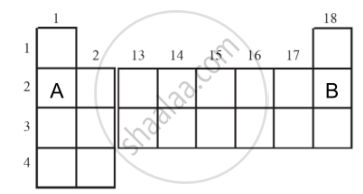
In the modern periodic table, the positions of 1 to 20 elements are shown here. Identify the elements A and B. Write their atomic number.
______ and ______ are called inner transition elements.
In the modern periodic table, elements are arranged according to their ______
The longest period of the Modern Periodic Table is period.
An element which is an essential constituent of all organic compounds belongs to
Three elements A, B and C have 3, 4 and 2 electrons respectively in their outermost shell. Give the group number to which they belong in the Modern Periodic Table. Also, give their valencies.
Choose an element from period 3 of modern periodic table that matches the description given below in instance. Give a reason for your choice.
It has variable valency and is a member of the Oxygen family (group 16).
What is the general name of the last elements of the Periodic Table?
