Advertisements
Advertisements
प्रश्न
Write a scientific reason.
There was ambiguity about the correct position of hydrogen in Mendeleev’s periodic table.
Advertisements
उत्तर
- Hydrogen resembles alkali metals. It has one electron in its outermost shell like alkali metals. Its valency is 1 like alkali metals. It forms oxides (H2O) similar to alkali metals (Na2O). However, hydrogen also resembles halogens. It is a diatomic molecule (H2) like halogens (F2, Cl2). It is one electron deficient to achieve stable electronic configuration similar to halogens.
- Due to this unique behaviour of hydrogen, it could not be decided whether the correct position of hydrogen is in the group of alkali metals or in the group of halogens.
Thus, there was ambiguity about the correct position of hydrogen in Mendeleev's periodic table.
APPEARS IN
संबंधित प्रश्न
Name two elements you would expect to show chemical reactions similar to magnesium. What is the basis for your choice?
In the Modern Periodic Table, which are the metals among the first ten elements?
Write the names given to the vertical columns and horizontal rows in the Modern Periodic Table. How does the metallic character of elements vary on moving down a vertical column? How does the size of atomic radius vary on moving left to right in a horizontal row? Give reason in support of your answer in the above two cases.
What is the significance of atomic number in the modern classification of elements? Explain with the help of an example.
How does the chemical reactivity of the halogens vary on going in group 17 of the periodic table?
Explain why all the elements of a period have different chemical properties.
State how the valency of elements varies in a period of the periodic table?
(b) What is the number of elements is 3rd period, the modern periodic table?
What is a group in the periodic table?
In what respects do the properties of group 1 elements differ from those of group 17 elements? Explain with examples by taking one element from each group.
How many groups and periods does the modern periodic table have?
Name two elements in each case:
Actinides
Name the noble gas with 3 shells.
Write a short note.
Structure of the modern periodic table.
How does number of (i) valence electrons (ii) valency; vary on moving from left to right in the second period of a periodic table?
Name the cation and the anion in the salt – calcium sulphate
Give the symbol and valency of the following element and radical.
Sulphur [Sulphide]
Give the symbol and valency of the following element and radical.
Oxygen [Oxide]
Give the symbol and valency of the following element and radical.
Ammonium
Give the symbol and valency of the following element and radical.
Bicarbonate
Give the symbol and valency of the following element and radical.
Bisulphite
Give the symbol and valency of the following element and radical.
Sulphate
The d-block elements are called as ______ elements.
Find the correlation:
Mendeleev’s periodic table : atomic mass : : Modern periodic table : _______
Find the odd one out and give its explanation.
Right or wrong sentence.
The modern periodic table has 1 to 7 periods.
Right or wrong sentence.
The modern periodic table shows the molecular masses of the elements in each frame.
Right or wrong sentence.
To the left of the zig-zag line in the periodic table are the metal elements.
Complete the following flow chart.
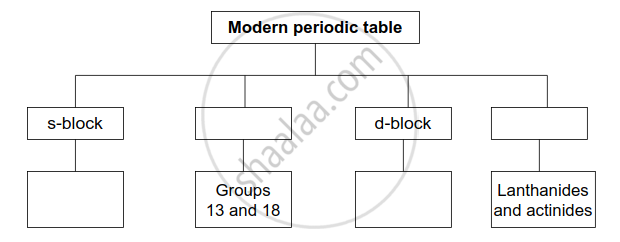
State whether true or false. If false, correct the statement.
Lanthanides and actinides are kept at the bottom of the periodic table because they resemble each other but they do not resemble with any other group elements.
Noble gases are placed in the ______ group in the modern periodic table.
Group 16 elements are collectively called as ______.
______ group elements are called alkaline earth metals.
A part of modern periodic table is given below. On its basis, answer the following questions:
| Group No. → | 1 | 2 | 13 | 14 | 15 | 16 | 17 | 18 |
| Period ↓ | ||||||||
| 2 | A | B | ||||||
| 3 | E | D | F | C |
Write the molecular formula of the compound formed by the combination:
A and F
A part of modern periodic table is given below. On its basis, answer the following questions:
| Group No. → | 1 | 2 | 13 | 14 | 15 | 16 | 17 | 18 |
| Period ↓ | ||||||||
| 2 | A | B | ||||||
| 3 | E | D | F | C |
Write the molecular formula of the compound formed by the combination:
E and B
Name two elements that you would expect to show chemical reactions similar to calcium. What is the basis of your choice?
Answer the following in respect of element \[\ce{_16^32S}\].
- Give its electronic configuration.
- To which group and period does it belon?
- What is its valency?
- Is it a metal or a non-metal?
- Is it a reducing agent or an oxidising agent?
- Give its formula with hydrogen.
