Advertisements
Advertisements
प्रश्न
The d-block elements are called as ______ elements.
विकल्प
transition
metalloid
normal
inner transition
Advertisements
उत्तर
The d-block elements are called as transition elements.
Explanation:
The d-block elements are known as transition elements because they are positioned between the highly reactive s-block metals and the less metallic p-block elements. Their properties represent a “transition” from the strongly electropositive nature of s-block metals to the covalent and non-metallic nature of p-block elements.
APPEARS IN
संबंधित प्रश्न
Why do all the elements of the same group have similar properties?
Give two example of group 17 elements.
What is the significance of atomic number in the modern classification of elements? Explain with the help of an example.
On which side of the periodic table will you find non-metals?
Would you place the two isotopes of chlorine, CI-35 and CI-37 in different slots because of their different atomic masses or in the same slot because their chemical properties are the same? Justify your answer.
Is it possible to have an element having atomic number 1.5 placed between hydrogen and helium?
Consider the following elements:
Na, Ca, Al, K, Mg, Li
Which of these elements belong to the same group of the periodic table?
Consider the following elements:
Ca, Cl, Na, I, Li, Ba, Sr, K, Br
Separate these elements into three groups (families) of similar properties. State one property in each case on the basis of which you have made your choice.
What is the usual number of valence electrons in the atoms of the last element in a period?
State whether the following statement is true or false:
On going down in a group of the periodic table, the number of valence electrons increases.
Explain why all the elements of a group have similar chemical properties.
What are the merits of the modern periodic table of elements?
What are the groups in a periodic table? Give two characteristics of each.
The atomic numbers of the three elements X, Y and Z are 2, 6 and 10 respectively.
(i) Which two elements belong to the same group?
(ii) Which two elements belong to the same period?
Give reasons for your choice.
An element X belongs to 3rd period and group 2 of the periodic table. State:
(a) number of valence electrons
(b) valency
(c) metal or non-metal
(d) name of the element
Define:
Periodic table
How many groups and periods does the modern periodic table have?
Name two elements in each case: Lanthanides
Arrange the elements of second and third periods in increasing order of their atomic size.
Third Period.
What is the main characteristic of the last element in each period of the periodic table?
Write a short note.
Structure of the modern periodic table.
What is the number of elements in the 1st period?
Name an element of group 18 which can form compounds.
Give the symbol and valency of the following element and radical.
Potassium
Give the symbol and valency of the following element and radical.
Zinc
Give the symbol and valency of the following element and radical.
Oxygen [Oxide]
Fill in the blank:
The element lithium in the Modern Periodic Table with valency 1+ belongs to the group ______.
Write a scientific reason.
There was ambiguity about the correct position of hydrogen in Mendeleev’s periodic table.
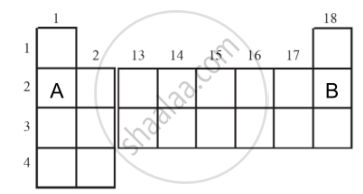
In the modern periodic table, the positions of 1 to 20 elements are shown here. Identify the elements A and B. Write their atomic number.
Distinguish between:
s-block - p-block
Elements in the modern periodic table are arranged in ______groups and______ periods.
The arrangement of elements in the Modern Periodic Table is based on their ______.
Choose an element from period 3 of modern periodic table that matches the description given below in instance. Give a reason for your choice.
It has a similar structure to diamond.
- Write the electronic configuration of element X, given by its symbol as under: \[\ce{^40_20 X}\]
- Determine its position in the modem periodic table.
- What is the nature of its oxide?
- Name one other element of its group.
Define periods of modern periodic table.
What is the general name of the last elements of the Periodic Table?
Answer the following in respect of element \[\ce{_16^32S}\].
To which group and period does it belong?
