Advertisements
Advertisements
प्रश्न
Answer the following in respect of element \[\ce{_16^32S}\].
- Give its electronic configuration.
- To which group and period does it belon?
- What is its valency?
- Is it a metal or a non-metal?
- Is it a reducing agent or an oxidising agent?
- Give its formula with hydrogen.
Advertisements
उत्तर
- Electronic configuration of \[\ce{_16^32S}\] is 16 = 2, 8, 6.
- 16S atomic number 16 belongs to group 16 (VI A) and has 2 shells belongs to period 3.
- Valency of 16S is (8 − 6) = 2−.
- It is Non-metal.
- It is an oxidising agent as it accepts electrons to complete an octet.
- Formula with H2 is H2S (Hydrogen sulphide).
APPEARS IN
संबंधित प्रश्न
The position of three elements A, B and C in the Periodic Table are shown below –
|
Group 16
|
Group 17
|
|
−
|
−
|
|
−
|
A
|
|
−
|
−
|
|
B
|
C
|
(a) State whether A is a metal or non-metal.
(b) State whether C is more reactive or less reactive than A.
(c) Will C be larger or smaller in size than B?
(d) Which type of ion, cation or anion, will be formed by element A?
where should hydrogen be placed in the modern periodic table? Give reason for your answer.
How would the tendency to lose electrons change as we go from left to right across a period of the periodic table?
On the basis of electronic configuration, how will you identify chemically similar elements?
What is the main characteristic of the last elements in the periods of the periodic table? What is the general name of such elements?
What are the periods in a periodic table?
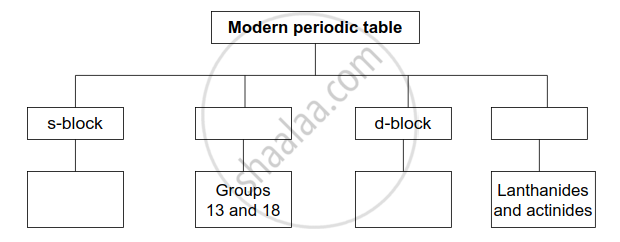
Complete the following flow chart.
Distinguish between:
s-block - p-block
How does the property vary in periods and in groups?
An element X which is a yellow solid at room temperature shows catenation and allotropy. X forms two oxides which are also formed during the thermal decomposition of ferrous sulphate crystals and are the major air pollutants.
- Identify the element X
- Write the electronic configuration of X
- Write the balanced chemical equation for the thermal decomposition of ferrous sulphate crystals?
- What would be the nature (acidic/ basic) of oxides formed?
- Locate the position of the element in the Modern Periodic Table.
