Advertisements
Advertisements
प्रश्न
Define groups of modern periodic table.
Advertisements
उत्तर
In the modern periodic table, groups (also known as families) are the 18 vertical columns that organize chemical elements by shared properties. Unlike periods, which are horizontal rows representing electron shells, groups are vertical columns of elements with similar chemical properties.
APPEARS IN
संबंधित प्रश्न
Write the merits of the modern periodic table over Mendeleev’s Periodic table
Fill in the following blank with suitable word:
Group 18 elements are called ...............
On which side of the periodic table will you find non-metals?
Name the scientist who prepared modern periodic table.
What is the major characteristic of the first elements in the periods of the periodic table? What is the general name of such elements?
What happens to the number of valence electrons in the atoms of elements as we go down in a group of the periodic table?
(b) What is the number of elements is 3rd period, the modern periodic table?
Consider the following elements:
20Ca, 8O, 18Ar, 16S, 4Be, 2He
Which of the above elements would you expect to be:
(i) very stable?
(ii) in group 2 of the periodic table?
(iii) in group 16 of the periodic table?
The elements A, B, C and D belong to groups 1, 2, 14 and 17 respectively of the periodic table. Which of the following pairs of elements would produce a covalent bond?
(i) A and D
(ii) C and D
(iii) A and B
(iv) B and C
(v) A and C
Define:
Periodic table
How many groups and periods does the modern periodic table have?
Name the metals in the first twenty elements.
Name the type of elements which have one electron short of octet.
What is the main characteristic of the last element in each period of the periodic table?
An element barium has the atomic number 56. Look up its position in the periodic table and answer the following question.
Is it larger or smaller than caesium (Cs)?
Name an alkali metal in period 3 and halogen in period 2.
State the modern periodic law for the classification of elements. How many (i) groups and (ii) periods are there in the modern periodic table?
Write a short note.
Position of isotopes in the Mendeleev’s and the modern periodic table.
How many periods and groups are there in the modern periodic table?
Name an element of group 18 which can form compounds.
In the Modern Periodic Table – atoms of all elements are arranged according to their increasing order of – atomic numbers. An atom of nitrogen has seven protons and seven electrons. State what would be its atomic number.
Give the symbol and valency of the following element and radical.
Chlorine [Chloride]
Give the symbol and valency of the following element and radical.
Ammonium
Give the symbol and valency of the following element and radical.
Carbonate
Give the chemical formula of ammonium sulphate
Give the chemical formula of calcium phosphate
Write a scientific reason.
Lithium and sodium are included in the same group in the periodic table.
Complete the following flow chart.
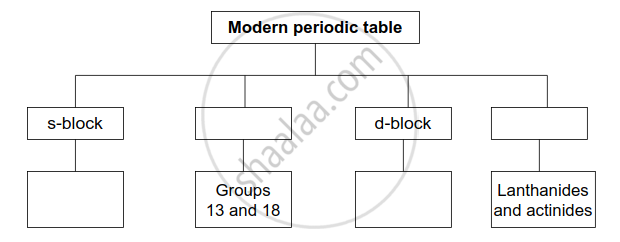
Explain structure of modern periodic table in short.
______ forms the basis of the modern periodic table.
Which of these belong to the same period?
| Element | A | B | C |
| Atomic number | 2 | 10 | 5 |
The element with atomic number 14 is hard and forms acidic oxide and a covalent halide. To which of the following categories does the element belong?
What is the symbol of the element Tungsten?
Which of the following elements would lose an electron easily?
Three elements A, B and C have 3, 4 and 2 electrons respectively in their outermost shell. Give the group number to which they belong in the Modern Periodic Table. Also, give their valencies.
Choose an element from period 3 of modern periodic table that matches the description given below in instance. Give a reason for your choice.
It has variable valency and is a member of the Oxygen family (group 16).
A part of modern periodic table is given below. On its basis, answer the following questions:
| Group No. → | 1 | 2 | 13 | 14 | 15 | 16 | 17 | 18 |
| Period ↓ | ||||||||
| 2 | A | B | ||||||
| 3 | E | D | F | C |
Which of the element is a Noble gas?
Give the criteria on the basis of which elements are placed (i) in a group and (ii) in a period in the modern periodic table. The atomic number of an element is 16. According to the criteria, in which group and period it should be placed?
