Advertisements
Advertisements
Question
Find the correlation:
Mendeleev’s periodic table : atomic mass : : Modern periodic table : _______
Advertisements
Solution
Mendeleev’s periodic table : atomic mass : : Modern periodic table : atomic number
Explanation:
Mendeleev organised his periodic table based on the atomic mass of elements. In contrast, the modern periodic table is based on the atomic number (the number of protons), which Henry Moseley demonstrated to be a more fundamental property for predicting periodic trends in chemical behaviour.
APPEARS IN
RELATED QUESTIONS
Write the names given to the vertical columns and horizontal rows in the Modern Periodic Table. How does the metallic character of elements vary on moving down a vertical column? How does the size of atomic radius vary on moving left to right in a horizontal row? Give reason in support of your answer in the above two cases.
Why do all the elements of the same group have similar properties?
Is it possible to have an element having atomic number 1.5 placed between hydrogen and helium?
State how the valency of elements varies in a group of the periodic table?
What is a period in a periodic table?
What is the usual number of valence electrons and valency of group 18 elements of the periodic table?
What happens to the number of valence electrons in the atoms of elements as we go down in a group of the periodic table?
Explain why, the first period of the periodic table has only two elements whereas second period has eight elements
What are the groups in a periodic table? Give two characteristics of each.
An element X belongs to 3rd period and group 2 of the periodic table. State:
(a) number of valence electrons
(b) valency
(c) metal or non-metal
(d) name of the element
Define:
Periodic table
How many groups and periods does the modern periodic table have?
Name two elements in each case: Lanthanides
Name two elements in each case:
Actinides
What is the main characteristic of the last element in each period of the periodic table?
An element barium has atomic number 56. Look up its position in the periodic table and answer the following question.
What will be the formula of its phosphate?
The electronic configuration of an element T is 2, 8, 8, 1.
What is the period number of T?
Name an element of group 18 which can form compounds.
An element A has 2 electrons in its fourth shell. State its electronic configuration.
Give the symbol and valency of the following element and radical.
Ammonium
Give the symbol and valency of the following element and radical.
Bisulphite
Give the symbol and valency of the following element and radical.
Hydroxide
Give the symbol and valency of the following element and radical.
Carbonate
Find the odd one out and give its explanation.
Write a scientific reason.
There was ambiguity about the correct position of hydrogen in Mendeleev’s periodic table.
Complete the following flow chart.
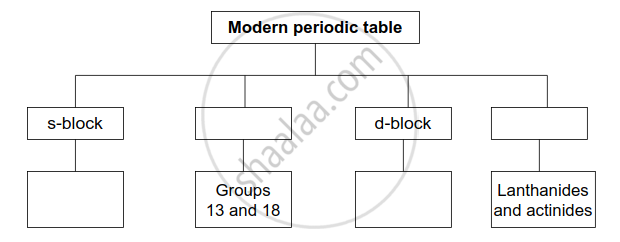
An X element with atomic number 11 and Y element with atomic number 13 belongs to the third period in the modern periodic table. With this information, give the answers of the below questions.
- Which element has more metallic character from these two elements?
- What is the valency of each X and Y elements?
- Atom size of Y element is smaller than atom size of X element? Explain?
Position of A, B and C three elements is given in the table from the modern periodic table. Answer the following questions.
| Periods | Group 2 | Group 17 |
| 2 | ----- | A |
| 3 | B | ----- |
| 4 | ----- | C |
- What is an element metal or nonmetal?
- Which is the outermost orbit of element B?
- Identify C element and it's physical state.
State any five features of modern periodic table.
The scientist who propounded the modern periodic law is ______.
On moving from left to right in a period in the periodic table, the size of the atom ______
The element with atomic number 14 is hard and forms acidic oxide and a covalent halide. To which of the following categories does the element belong?
The three elements A, B and C with similar properties have atomic masses X, Y and Z respectively. The mass of Y is approximately equal to the average mass of X and Z. What is such an arrangement of elements called as? Give one example of such a set of elements.
Three elements A, B and C have 3, 4 and 2 electrons respectively in their outermost shell. Give the group number to which they belong in the Modern Periodic Table. Also, give their valencies.
Spot the error:
There are 5 periods and 17 groups in the modern periodic table.
What is the general name of the last elements of the Periodic Table?
Name the following metal:
A metal present in period 3, group 1 of the periodic table.
Match the atomic number with the following:
An element of group 2.
