Advertisements
Advertisements
Question
Find the correlation:
Group 1 and 2 : s block : : group 13 and 18 : ______
Advertisements
Solution
Group 1 and 2 : s block : : group 13 and 18 : p Block
Explanation:
The modern periodic table is divided into blocks based on the orbital being filled by the valence electrons:
- s-block: Includes Groups 1 and 2, where the last electron enters the s-orbital.
- p-block: Includes Groups 13 to 18, where the last electron enters the p-orbital.
APPEARS IN
RELATED QUESTIONS
Name two elements you would expect to show chemical reactions similar to magnesium. What is the basis for your choice?
The position of three elements A, B and C in the Periodic Table are shown below –
|
Group 16
|
Group 17
|
|
−
|
−
|
|
−
|
A
|
|
−
|
−
|
|
B
|
C
|
(a) State whether A is a metal or non-metal.
(b) State whether C is more reactive or less reactive than A.
(c) Will C be larger or smaller in size than B?
(d) Which type of ion, cation or anion, will be formed by element A?
Compare and contrast the arrangement of elements in Mendeleev’s periodic Table and the Modern Periodic Table.
Fill in the following blank with suitable word:
The horizontal rows in a periodic table are called ...............
Fill in the following blank with suitable word:
Group 17 elements are known as ...............
Fill in the following blank with suitable word:
Group 18 elements are called ...............
Is it possible to have an element having atomic number 1.5 placed between hydrogen and helium?
State whether the following statement is true or false:
On going down in a group of the periodic table, the number of valence electrons increases.
What is the fundamental difference in the electron configurations between the group 1 and group 2 elements?
What is the number of elements is 1st period the modern periodic table?
In the modern Periodic Table, why does cobalt with higher atomic mass of 58.93 appear before nickel having lower atomic mass of 58.71?
The atomic numbers of the three elements X, Y and Z are 2, 6 and 10 respectively.
(i) Which two elements belong to the same group?
(ii) Which two elements belong to the same period?
Give reasons for your choice.
Consider the following elements:
20Ca, 8O, 18Ar, 16S, 4Be, 2He
Which of the above elements would you expect to be:
(i) very stable?
(ii) in group 2 of the periodic table?
(iii) in group 16 of the periodic table?
Give the group number of following elements present in periodic table
Correct the statement.
Transition elements are placed at extreme right of the periodic table.
Name the type of elements which have one electron short of octet.
Name an alkali metal in period 3 and halogen in period 2.
An element E has following electronic configuration:
|
K |
L |
M |
|
2 |
8 |
6 |
(a) To which group of the periodic table does element E belong?
(b) To which period of the periodic table does element E belong?
(c) State the number of valence electrons present in element E.
(d) State the valency of the element E.
What would be the correct order if Zn, Fe, Al and Cu are arranged in increasing order of reactivity?
Give the symbol and valency of the following element and radical.
Hydrogen
Give the symbol and valency of the following element and radical.
Nitrate
Give the symbol and valency of the following element and radical.
Bisulphite
Give the chemical formula of sodium bicarbonate
State the number of elements in Period 3 of the Periodic Table.
The d-block elements are called as ______ elements.
Right or wrong sentence.
The K and L shells of the elements Na and Mg contain electrons.
Complete the following flow chart.
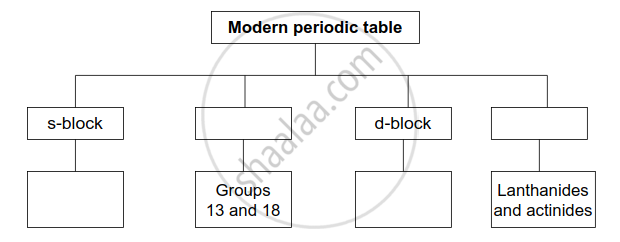
Explain structure of modern periodic table in short.
The arrangement of elements in the Modern Periodic Table is based on their ______.
The element with atomic number 14 is hard and forms acidic oxide and a covalent halide. To which of the following categories does the element belong?
The amount of energy released when one or more electrons is added to the neutral atom is ______
What is the symbol of the element Tungsten?
Choose an element from period 3 of modern periodic table that matches the description given below in instance. Give a reason for your choice.
It has variable valency and is a member of the Oxygen family (group 16).
- Write the electronic configuration of element X, given by its symbol as under: \[\ce{^40_20 X}\]
- Determine its position in the modem periodic table.
- What is the nature of its oxide?
- Name one other element of its group.
Explain giving reason why although the nuclear charge in atoms increases in moving from left to right in a period as well as in moving from top to bottom in a group in the Modern periodic table, but the size of the atoms does not vary similarly in both situations.
An element has 2 electrons in its N shell.
Is it a metal or a non-metal?
Match the atomic number with the following:
A rare gas.
A group of elements in the periodic table is given below (Boron is the first member of the group and Thallium is the last).
Boron, Aluminium, Gallium, Indium, Thallium
Answer the following question in relation to the above group of elements:
If the electronic configuration of aluminium is 2, 8, 3, how many electrons are there in the outer shell of thallium?
