Advertisements
Advertisements
Question
Referring closely, to Act III Scene III, relate the stern warning of Ariel to the "three men of sin". What impact does his warning have on the three sinners?
Advertisements
Solution
In Act III, Scene III of "The Tempest," Ariel delivers a stern warning to the "three men of sin" - Alonso, Sebastian, and Antonio. This warning has a profound impact on the three sinners, marking a crucial moment in the play's development. Positioned high above the stage, Prospero observes with satisfaction the consequences of his spells on those who conspired against him twelve years ago. After the shipwreck, the guilty ones, including Old Gonzalo, have been wandering in the enchanted island's pathless wilderness, searching for the missing Ferdinand.
The magical sequence takes the form of a masque of hospitality, resembling an episode from Virgil's Aeneid. Ariel, appearing as a harpy, explains the significance of the disrupted harmony, fellowship, and natural order symbolized by the ceremonial banquet. This disruption is attributed to the 'three men of sin,' and Ariel insists they must recognize the magnitude of their offenses. The injury to Prospero is portrayed as an affront to the entire scheme of things, making them unfit to live amongst men. They have been rejected and vomited up by the sea.
Ariel's warning leaves the sinners with only one hope - repentance and a change in their ways, marked by 'heart's sorrow' and the pursuit of a clear life. Prospero commends Ariel for the harpy performance and departs, leaving the sinners to grapple with the fearsome accusation. Alonso acknowledges his guilt, expressing it as monstrous. Sebastian and Antonio remain defiant, while Gonzalo, despite unclear understanding, appears to comprehend the gravity of the situation. The impact of Ariel's warning sets the stage for potential redemption and self-reflection among the 'three men of sin.'
APPEARS IN
RELATED QUESTIONS
Answer of these question in two or three paragraphs (100 –150 words).
Do you agree with Margie that schools today are more fun than the school in the story?
Give reasons for your answer.
Thinking about the Poem
What does the poet say the wind god winnows?
Find the sentences in the text where these words occur:
|
erupt |
surge | trace | undistinguished | casualty |
Look these words up in a dictionary which gives examples of how they are used.
Now answer the following questions.
1. What are the things that can erupt? Use examples to explain the various meanings of erupt. Now do the same for the word surge. What things can surge?
2. What are the meanings of the word trace and which of the meanings is closest to the word in the text?
3. Can you find undistinguished in your dictionary? (If not, look for the word distinguished and say what undistinguished mean.)
Why does the lost child lose interest in the things that he had wanted earlier?
How does Toto take a bath? Where has he learnt to do this? How does Toto almost boil himself alive?
Based on your reading of the story answer the following question by choosing the correct option:
Duke never jumped on Chuck again because ________
Listen to the poem.
Oh, I wish I'd looked after me teeth,
And spotted the perils beneath.
All the toffees I chewed,
And the sweet sticky food,
Oh, I wish I'd looked after me teeth.
I wish I'd been that much more willin'
When I had more tooth there than fillin'
To pass up gobstoppers.
From respect to me choppers,
And to buy something else with me shillin'.
When I think of the lollies I licked,
And the liquorice all sorts I picked,
Sherbet dabs, big and little,
All that hard peanut brittle,
My conscience gets horribly pricked.
My mother, she told me no end.
'If you got a tooth, you got a friend.'
I was young then, and careless,
My toothbrush was hairless,
I never had much time to spend.
Oh, I showed them the toothpaste all right,
I flashed it about late at night,
But up-and-down brushin'
And pokin' and fussin'
Didn't seem worth time-I could bite!
If I'd known, I was paving the way
To cavities, caps and decay,
The murder of fillin's
Injections and drillin's,
I'd have thrown all me sherbet away.
So I lay in the old dentist's chair,
And I gaze up his nose in despair,
And his drill it do whine,
In these molars of mine.
"Two amalgum," he'll say, "for in there."
How I laughed at my mother's false teeth,
As they foamed in the waters beneath.
But now comes the reckonin'
It's me they are beckonin'
Oh, I wish I'd looked after me teeth.
About the Poet
Pam Ayres (1947- ) is a contemporary writer, a great entertainer who writes and performs
comic verse. She started writing poems and verses as a hobby and has appeared in every
major TV show in the U.K. She has published six books of poems, and cut seven record
albums including a collection of 50 best known poems.
The most important thing we've learned,
So far as children are concerned,
Is never, NEVER, NEVER let
Them near your television set-----
Or better still, just don't install
The Idiotic thing at all.
In almost every house we've been,
we've watched them gaping at the screen
They loll and slop and lounge about,
And stare until their eyes pop out.
(Last week in someone's place we saw
A dozen eyeballs on the floor.
They sit and stare and stare and sit
Until they're hypnotised by it,
Until they're absolutely drunk
With all that shocking ghastly junk.
Read the lines given above and answer the question given below.
What is the most important thing that the poet has learnt?
We will ponder your proposition and when we decide we will let you know. But should we accept it, I here and now make this condition that we will not be denied the privilege without molestation of visiting at any time the tombs of our ancestors, friends, and children. Every part of this soil is sacred in the estimation of my people. Every hillside, every valley, every plain and grove, has been hallowed by some sad or happy event in days long vanished. Even the rocks, which seem to be dumb and dead as the swelter in the sun along the silent shore, thrill with memories of stirring events connected with the lives of my people, and the very dust upon which you now stand responds more lovingly to their footsteps than yours, because it is rich with the blood of our ancestors, and our bare feet are conscious of the sympathetic touch. Our departed braves, fond mothers, glad, happy hearted maidens, and even the little children who lived here and rejoiced here for a brief season, will love these somber solitudes and at eventide they greet shadowy returning spirits. And when the last Red Man shall have perished, and the memory of my tribe shall have become a myth among the White Men, these shores will swarm with the invisible dead of my tribe^ and when your children’s children think themselves alone in the field, the store, the shop, upon the highway, or in the silence of the pathless woods, they will not be alone. In all the earth there is no place dedicated to solitude. At night when the streets of your cities and villages are silent and you think them deserted, they will throng with the returning hosts’that once filled them and still lover this beautiful land. The White Man will never be alone.
Let him be just and deal kindly with my people, for the dead are not powerless. Dead, did I say? There is no death, only a change of worlds.
Read the extract given below and answer the question that follow.
When will the shores swarm with the invisible dead of the speaker’s tribe? Why?
She again rubbed a match on the wall, and the light shone round her; in the brightness stood her old grandmother, clear and shining, yet mild and loving in her appearance. “Grandmother,” cried the little one, “O take me with you; I know you will go away when the match burns out; you will vanish like the warm stove, the roast goose, and the large, glorious Christmas-tree.” And she made haste to light the whole bundle of matches, for she wished to keep her grandmother there. And the matches glowed with a light that was brighter than the noon-day, and her grandmother had never appeared so large or so beautiful. She took the little girl in her arms, and they both flew upwards in brightness and joy far above the earth, where there was neither cold nor hunger nor pain, for they were with God.
In the dawn of morning there lay the poor little one, with pale cheeks and smiling mouth, leaning against the wall; she had been frozen to death on the last evening of the year; and the New-year’s sun rose and shone upon a little corpse! The child still sat, in the stiffness of death, holding the matches in her hand, one bundle of which was burnt. “She tried to warm herself,” said some. No one imagined what beautiful things she had seen, nor into what glory she had entered with her grandmother, on New-year’s day.
Read the extract given below and answer the question that follow.
What did the girl say to her grandmother? Why?
Then there it lay in her wet palm, perfect, even pierced ready for use, with the sunset shuffled about inside it like gold—?dust. All her heart went up in flames of joy. After a bit she twisted it into the top of her skirt against her tummy so she would know if it burst through the poor cloth and fell. Then she picked up her fork and sickle and the heavy grass and set off home. Ai! Ai! What a day! Her barefeet smudged out the wriggle— ?mark of snakes in the dust; there was the thin singing of malaria mosquitoes among the trees now; and this track was much used at night by a morose old makna elephant—the Tuskless One; but Sibia was not thinking of any of them. The stars came out: she did not notice. On the way back she met her mother, out of breath, come to look for her, and scolding. “I did not see till I was home, that you were not there. I thought something must have happened to you.” And Sibia, bursting with her story, cried “Something did). I found a blue bead for my necklace, look!”
Read the extract given below and answer the question that follow.
What all did Sibia not notice as she went home?
What is the beating of the heart compared to ? How is the heart described ? IV/wt does the beating of the heart remind us of?
Complete the following sentences.
(i) Toto climbed up the curtains when ————————————————————————————————
(ii) _________________________________________________———————————————————————, I became one of the tiger’s favourites.
iii) Timothy had clean habits, ___________________ ————————————————————————————————————
What did Number One and Number Two suggest should be done about the alien spacecraft?
How did the king and the hermit help the wounded man?
Answer the following question
How did Gopal get inside the palace to see the king after he had bought the fish?
Why did the wicked couple drop their tools?
Author’s friend had taken out the parts of the bicycle easily, but he really had tough time fixing them Explain this with suitable example.
“The watch was nothing special and yet had great powers.” In what sense did it have ‘great powers’?
What happens when we are asleep?
Why did the talking fan’s chatter come to an end?
Find pictures of the kinds of birds, insects and scenes mentioned in the poem.
Use the clues given below to complete this crossword puzzle.
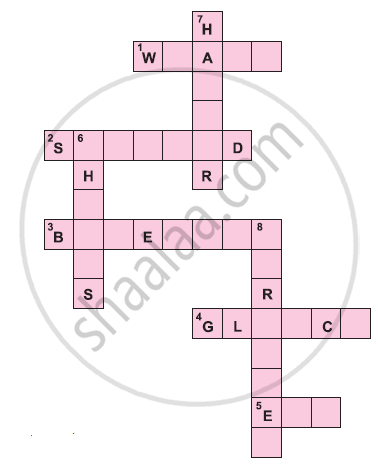
Across
1. very tired
2. had an angry look on the face
3. short trousers
4. a fault in a machine that prevents it from working properly
5. a small and naughty boy-fairy
Down
6. work that must be done every day, often boring
7. a basket with a lid
8. gave a short, high-pitched cry
Why did the magic waterfall disappoint other villagers? What reward did Taro get and from whom?
Complete the following sentence.
The old banyan tree “did not belong” to grandfather, but only to the boy, because _________
Talk to your partner and say whether the following statement is true or false.
Deserts are endless sand dunes.
Multiple Choice Question:
The poet asks us to think and find proper words to_________.
Answer the following question.
“Then the situation changed.” What is being referred to?
Choose a befitting adjective to describe the nature of squirrel.
The words helper, companion, partner and accomplice have very similar meanings, but each word is typically used in certain phrases. Can you fill in the blanks below with the most commonly used words? A dictionary may help you.
a faithful …………… such as dog.
