English

Use the clues given below to complete this crossword puzzle. - English

Advertisements
Advertisements

Question

Use the clues given below to complete this crossword puzzle.
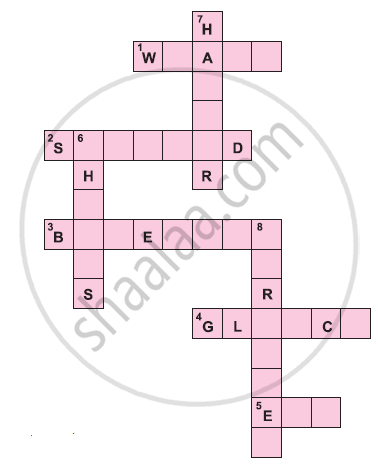
Across

1. very tired
2. had an angry look on the face
3. short trousers
4. a fault in a machine that prevents it from working properly
5. a small and naughty boy-fairy

Down

6. work that must be done every day, often boring
7. a basket with a lid
8. gave a short, high-pitched cry

Answer in Brief
Advertisements

Solution

Across

1. very tired - Weary
2. had an angry look on the face - Scowled
3. short trousers - Breeches
4. a fault in a machine that prevents it from working properly - Glitch
5. a small and naughty boy-fairy - Elf

Down

6. work that must be done every day, often boring - Chores
7. a basket with a lid - Hamper
8. gave a short, high-pitched cry - Shrieked

shaalaa.com
Reading
  Is there an error in this question or solution?
Chapter 1.1: Who Did Patrick’s Homework? - Working with Language [Page 12]

APPEARS IN

NCERT English - Honeysuckle Class 6
Chapter 1.1 Who Did Patrick’s Homework?
Working with Language | Q 1 | Page 12

RELATED QUESTIONS

Who had these opinion about Einstein?

He was a freak.


Mahendra calls ghosts or spirits a figment of the imagination. What happens to him on a full-moon night?


Six humans trapped by happenstance
In black and bitter cold.
Each one possessed a stick of wood,
Or so the story's told.
Their dying fire in need of logs;
The first man held his back.
For on the faces around the fire,
He noticed one was black.

Read the lines given above and answer the question that follow:

Explain the symbolism used by the poet.


Some are Purple and gold flecked grey
For she who has journeyed through life midway,
Whose hands have cherished , whose love has blest,
And cradled fair sons on her faithful breast,
And serves her household in fruitful pride,
And worship the gods at her husband's side.

Read the lines given above and answer the question that follow:

What’kinds of bangles have earlier been mentioned?


Such wondrous, fine, fantastic tales
Of dragons, gypsies, queens, and whales
And treasure isles, and distant shores
Where smugglers rowed with muffled oars,
And pirates wearing purple pants,
And sailing ships and elephants,
And cannibals crouching 'round the pot,
Stirring away at something hot.
(It smells so good , what can it be?
Good gracious, it's Penelope.)
The younger ones had Beatrix Potter
With Mr.Tod,the dirty rotter,
And Squirrel Nutkin,Pigling Bland,
And Mrs.Tiggy-Winkle and-
Just How The Camel Got His Hump,
And How the Monkey Lost His Rump,
And Mr. Toad, and bless my soul,
There's Mr.Rat and Mr. Mole-
Oh, books, what books they used to know,
Those children living long ago!

Read the lines given above and answer the question given below.

To which author does Dahl pay a tribute?


It matters little where we pass the remnant of our days. They will not be many. The Indian’s night promises to be dark. Not a single star of hope hovers above his horizon. Sad-voiced winds moan in the distance. Grim fate seems to be on the Red Man’s trail, and wherever he will hear the approaching footsteps of his fell destroyer and prepare stolidly to meet his doom, as does the wounded doe that hears the approaching footsteps of the hunter.

A few more moons, a few more winters, and not one of the descendants of the mighty hosts that once moved over this broad land or lived in happy homes, protected by the Great Spirit, will remain to mourn over the graves of a people once more powerful and hopeful than yours. But why should I mourn at the untimely fate of my people? Tribe follows tribe, and nation follows nation, like the waves of the sea. It is the order of nature, and regret is useless. Your time of decay may be distant, but it will surely come, for even the White Man whose God walked and talked with him as friend to friend, cannot be exempt from the common destiny. We may be brothers after all. We will see.

Read the extract given below and answer the question that follow.

How does the speaker realize that he should not mourn the untimely fate of his people?


It was my business to cross the bridge, explore the bridge head 3 beyond and find out to what point the enemy had advanced. I did this and returned over the bridge. There were not so many carts now and very few people on foot, but the old man was still there.’’Where do you come from?” I asked him.
“From San Carlos,” he said, and smiled.
That was his native town and so it gave him pleasure to mention it and he smiled.
“I was taking care of animals,” he explained.
“Oh,” I said, not quite understanding.
“Yes,” he said, “I stayed, you see, taking care of animals. I was the last one to leave the town of San Carlos.”
He did not look like a shepherd nor a herdsman and I looked at his black dusty clothes and his gray dusty face and his steel rimmed spectacles and said, “What animals were they?”
“Various animals,” he said, and shook his head. “I had to leave them.”

Read the extract given below and answer the question that follow.

What was the name of the old man’s native town?


At Denver there was an influx of passengers into the coaches on the eastbound B. & M. express. In one coach there sat a very pretty young woman dressed in elegant taste and surrounded by all the luxurious comforts of an experienced traveler. Among the newcomers were two young men, one of handsome presence with a bold, frank countenance and manner; the other a ruffled, glum-faced person, heavily built and roughly dressed. The two were handcuffed together.

As they passed down the aisle of the coach the only vacant seat offered was a reversed one facing the attractive young woman. Here the linked couple seated themselves. The young woman’s glance fell upon them with a distant, swift disinterest; then with a lovely smile brightening her countenance and a tender pink tingeing her rounded cheeks, she held out a little gray-gloved hand. When she spoke her voice, full, sweet, and deliberate, proclaimed that its owner was accustomed to speak and be heard.

“Well, Mr. Easton, if you will make me speak first, 1 suppose 1 must. Don’t vou ever recognize old friends when you meet them in the West?”

The younger man roused himself sharply at the sound of her voice, seemed to struggle with a slight embarrassment which he threw off instantly, and then clasped her fingers with his left hand.

“It’s Miss Fairchild,” he said, with a smile. “I’ll ask you to excuse the other hand; “it’s otherwise engaged just at present.”

He slightly raised his right hand, bound at the wrist by the shining “bracelet” to the left one of his companion.

Read the extract given below and answer the question that follow.

Why does the author call the two men as the ‘linked couple?’


It was the summer of 1936. The Olympic Games were being held in Berlin. Because Adolf Hitler childishly insisted that his performers were members of a “master race,” nationalistic feelings were at an all-time high.

I wasn’t too worried about all this. I’d trained, sweated and disciplined myself for six years, with the Games in mind. While I was going over on the boat, all I could think about was taking home one or two of those gold medals. I had my eyes especially on the running broad jump. A year before, as a sophomore at the Ohio State, I’d set the world’s record of 26 feet 8 1/4 inches. Nearly everyone expected me to win this event.

Read the extract given below and answer the question that follow.

Why was Owens expected to win the gold medal in the Long Jump hands down?


I was in for a surprise. When the time came for the broad-jump trials, I was startled to see a tall boy hitting the pit at almost 26 feet on his practice leaps! He turned out to be a German named Luz Long. 1 was told that Hitler hoped to win the jump with him. I guessed that if Long won, it would add some new support to the Nazis’ “master race” (Aryan superiority) theory. After all, I am a Negro. Angr about Hitler’s ways, 1 determined to go out there and really show Der Fuhrer and his master race who was superior and who wasn’t. An angry athlete is an athlete who will make mistakes, as any coach will tell you. I was no exception. On the first of my three qualifying jumps, I leaped from several inches beyond the takeoff board for a foul. On the second jump, I fouled even worse. “Did I come 3,000 miles for this?” I thought bitterly. “To foul out of the trials and make a fool of myself ?” Walking a few yards from the pit, 1 kicked disgustedly at the dirt.

Read the extract given below and answer the question that follow.

“Did I come all the way from America for this?” I thought bitterly. “To foul out of the trials and make a fool of myself?” What does this show?


Read the extract given below and answer the questions that follow:

Portia: ........But this reasoning is not in fashion to choose me a husband. O me, the word “choose”! I may neither choose who I would nor refuse whom I dislike; so is the will of a living daughter curbed by the will of a dead father. Is it not hard, Nerissa, that I cannot choose one, nor refuse none?

(i) What test had Portia’s father devised for her suitors? What oath did the suitors have to take before making their choice? [3]
(ii) Who is Nerissa? What does she say to cheer up Portia? [3]
(iii) Why does Portia disapprove of the County Palatine? Who would she rather marry? [3]
(iv) How, according to Portia, can the Duke of Saxony’s nephew be made to choose the wrong casket? What do these suitors ultimately decide? Why? [3]
(v) Whom does Portia ultimately marry? Who were the two other suitors who took the test? Why, in your opinion, is the person whom she marries worthy of her? [4]


Read the following passage carefully and answer the questions that follow:
Richard Parker was so named because of a clerical error.
A panther was terrorizing the Khulna district of Bangladesh, just outside the Sundarbans. It had recently carried off a little girl. She was the seventh person killed in two months by the animal. And it was growing bolder. The previous victim was a man who had been attacked in broad daylight in his field. The beast dragged him off into the forest, and his corpse was later found hanging from a tree. The villagers kept a watch nearby that night, hoping to surprise the panther and kill it, but it never appeared.
The Forest Department hired a professional hunter. He set up a small, hidden platform in a free near a river where two of the attacks had taken place. A goat was tied to a stake on the river’s bank. The hunter waited several nights. He assumed the panther would be an old, wasted male with worn teeth, incapable of catching anything more difficult than a human. But it was a sleek tiger that stepped into the open one night: a female with a single cub. The goat bleated. Oddly, the cub, who looked to be about three months old, paid little attention to the goat. It raced to the water’s edge, where it drank eagerly. Its mother followed it. Of hunger and thirst, thirst is the greater urge. Only once the tiger had quenched her thirst did she turn to the goat to satisfy her hunger.
The hunter had two rifles with him: one with real bullets, the other with immobilizing darts. This animal was not the man-eater, but so close to human habitation she might pose a threat to the villagers, especially as she was with cub. He picked up the gun with the darts. He fired as the tiger was about to attack the goat. The tiger reared up and snarled and raced away. But immobilizing darts don’t bring on sleep gently—they knock the creature out without warning. A burst of activity on the animal’s part makes it act all the faster. The hunter called his assistants on the radio. They found the tiger about two hundred yards from the river. She was still conscious. Her back legs had given way and her balance on her front legs was shaky. When the men got close, she tried to get away but could not manage it. She turned on them, lifting a paw that was meant to kill. It only made her lose her balance. She collapsed and the Pondicherry Zoo had two new tigers. The cub was found in a bush close by, meowing with fear.
The hunter, whose name was Richard Parker, picked it up with his bare hands and, remembering how it had rushed to drink in the river, named it Thirsty. But the shipping clerk at the Howrah train station was evidently a man both confused and diligent. All the papers received with the cub clearly stated that its name was Richard Parker, that the hunter’s first name was Thirsty add that his family name was None Given. Richard Parker’s name stuck. I don’t know if the hunter was ever called Thirsty None Given!

(a) Give the meaning of each of the following words as used in the passage.
One word answers ob short phrases will be accepted.

  1. corpse (line 6)
  2. quenched (line 16)
  3. reared (line 20)

(b) Answer the following questions briefly in your own words.

  1. Why does the author say that the panther ‘was getting bolder’? 
  2. Why did the Forest Department hire a professional hunter? 
  3. What did the hunter expect to encounter? What did he actually encounter? 
  4. What did the tiger do before turning to attack the goat? Why did it do that? 
  5. Why did the hunter decide to shoot the tiger though he knew it was not the man-eater?
  6. What name did the hunter give to the cub? Why? 

(c)

(i) In not more than 60 words narrrate how the hunter and his assistants captured the tiger and her cub. 
(ii) Give a suitable title to your summary in 3(c). Give a reason to justify your choice. 


Read the extract give below and answer the questions that follow:

All around the field spectators were gathered Cheeril!g on all the young women and men Then the final event of the day was approaching The last race about the beginning. 
- Nine Gold Medals, David Roth 

(i) Where had the 'young women and men' come from? What had brought them together? How had they prepared themselves for the event?

(ii) What was the last event of the day? How many athletes were participating in this event? What signal were they waiting for? 

(iii) What happened to the youngest athlete halfway through the race? How did he respond? 

(iv) What 'strange' tum did the story take at this point? 

(v) Why does the poet say that the banner - 'Special Olympics' could not have been nearer the mark? What human quality does the poem celebrate?


Complete the following sentences.

i. An ant is the smallest,————————————————————————————————

ii. We know a number of facts about an ant’s life because————————————————————————————————


Why did the bearded man press his stomach with his hand?


How did Golu help the python?


Why did Abbu Khan feel sad?


Why was the crocodile’s wife annoyed with her husband one day?


What was the real aim of Miss Beam’s school?


Why does the speaker say that “there isn’t anyone staring or making strange noises”?


Share
Notifications

Englishहिंदीमराठी


      Forgot password?
Use app×