Advertisements
Advertisements
Question
Choose a befitting adjective to describe the nature of squirrel.
Options
Playful
Scornful
Introvert
Jealous
Advertisements
Solution
Playful
RELATED QUESTIONS
Answer these question in a few words or a couple of sentence.
What do you think a telebook is?
Thinking about the Poem
In stanza 1, find five ways in which we all are alike. Pick out the words.
Thinking about the Poem
Is it a harmful snake? What is its colour?
Activity:
Find Dhanuskodi and Rameswaram on the map. What language(s) do you think are spoken there? What languages do you think the author, his family, his friends and his teachers spoke with one another?

Pick out word from the text that mean the same as the following word or expression. (Look in the paragraph indicated.)
the power to endure, without falling ill : _________
Now rewrite the pair of sentences given below as one sentence.
I never thought of quitting. I knew what I wanted.
Based on your reading of the story answer the following question by choosing the correct option:
The author says that Duke ‘knew his job’ The job was __________
Parents alone are responsible for inculcating a good sense of dental hygiene amongst children. Do you agree/disagree? Discuss with your partner.
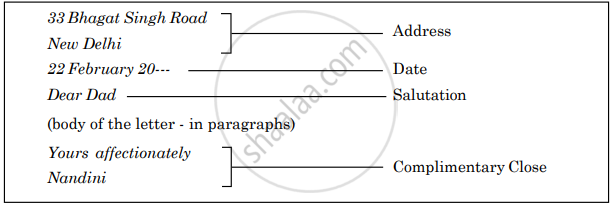
When we write informal letters (to a friend, or to a member of our family), we use this layout.
Listen carefully while your teacher reads out the description of a villa on sale mentioned on page 146. Based on the information, draw the sketch of the Villa being described.
Exceeding peace had made Ben Adhem bold,
And to the presence in the room he said,
"What writest thou?"..... The vision raised its head,
And with a look made of all sweet accord,
Answered, "The names of those who love the Lord."
Read the lines given above and answer the following question.
What did Abou Adhem ask the angel?
The village consisted of less than thirty houses, only one of them built with brick and cement. Painted a brilliant yellow and blue all over with gorgeous carvings of gods and gargoyles on its balustrade, it was known as the Big House. The other houses, distributed in four streets, were generally of bamboo thatch, straw, mud, and other unspecified material. Muni’s was the last house in the fourth street, beyond which stretched the fields. In his prosperous days Muni had owned a flock of forty sheep and goats and sallied forth every morning driving the flock to the highway a couple of miles away.
Read the extract given below and answer the question that follow.
What had Muni owned in his days of prosperity? What did he do every morning?
“So that is what you are doing out here? A marshal!” “My dear Miss Fairchild,” said ’ Easton, calmly, “I had to do something. Money has & way of taking wings unto itself, and
you know it takes money to keep step with our crowd in Washington. I saw this opening in the West, and—well, a marshalship isn’t quite as high a position as that of ambassador, but—” “The ambassador,” said the girl, warmly, “doesn’t call any more. He needn’t ever have done so. You ought to know that. And so now you are one of these dashing Western heroes, and you ride and shoot and go into all kinds of dangers. That’s different from the Washington life. You have been missed from the old crowd.” The girl’s eyes, fascinated, went back, widening a little, to rest upon the glittering handcuffs. “Don’t you worry about them, miss,” said the other man. “All marshals handcuff themselves to their prisoners to keep them from getting away. Mr. Easton knows his business.” “Will we see you again soon in Washington?” asked the girl. “Not soon, I think,” said Easton. “My butterfly days are over, I fear.”
Read the extract given below and answer the question that follow.
Easton says, “it takes money to keep step with our crowd in Washington.” What do you suppose he means by this?
“Do the scientists really know? Will it happen today, will it ?”
“Look, look; see for yourself !”The children pressed to each other like so many roses, so many weeds, intermixed, peering out for a look at the hidden sun. It rained. It had been raining for seven years; thousands upon thousands of days compounded and filled from one end to the other with rain, with the drum and gush of water, with the sweet crystal fall of showers and the concussion of storms so heavy they were tidal waves come over the islands. A thousand forests had been crushed under the rain and grown up a thousand times to be crushed again. And this was the way life was forever on the planet Venus, and this was the schoolroom of the children of the rocket men and women who had come to a raining world to set up civilization and live out their lives.
Read the extract given below and answer the question that follow.
What is supposed to happen on this particular day?
Why does Portia disapprove of the County Palatine? Who would she rather marry?
Multiple Choice Question:
The word ‘stucco’ means the same as ________
Complete the following sentence.
The old banyan tree “did not belong” to grandfather, but only to the boy, because _________
What does the phrase “take to task in the above passage mean?
Teasing is the poet’s way of ______ with the squirrel.
Find out the meaning of the following words by looking them up in the dictionary. Then use them in sentences of your own.
mystic
