Advertisements
Advertisements
Question
Thinking about the Text
Discuss in pairs and answer question below in a short paragraph (30 − 40 words).
How many characters are there in the narrative? Name them. (Don’t forget the dog!).
Advertisements
Solution
There are four characters in the narrative. They are Jerome (the narrator), George, Harris and Montmorency (the dog).
RELATED QUESTIONS
Thinking about the Text
Answer these question.
What is Gerrard’s profession? Quote the parts of the play that support your answer.
Thinking about the Text
Answer these question.
A mystery I propose to explain.” What is the mystery the speaker proposes to explain?
Thinking about the poem
What do you think the last two lines of the poem mean? (Looking back, does the poet regret his choice or accept it?)
Pick out word from the text that mean the same as the following word or expression. (Look in the paragraph indicated.)
the power to endure, without falling ill : _________
Answer the following question in one or two sentences.
Had Abdul Kalam earned any money before that? In what way?
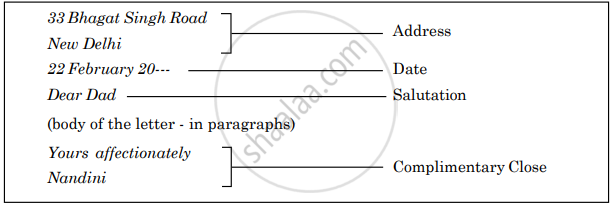
When we write informal letters (to a friend, or to a member of our family), we use this layout.
The black man's face bespoke revenge
As the fire passed from his sight.
For all he saw in his stick of wood
Was a chance to spite the white.
The last man of this forlorn group
Did nought except for gain.
Giving only to those who gave
Was how he played the game.
Their logs held tight in death's still hands
Was proof of human sin.
They didn't die from the cold without
They died from the cold within.
Read the lines given above and answer the question that follow.
Analyse the title and whether it is appropriate.
Abou Ben Adhem (may his tribe increase!)
Awoke one night from a deep dream of peace,
And saw, within the moonlight in his room,
Making it rich, and like a lily in bloom,
An angel writing in a book of gold:-
Read the lines given above and answer the following question.
What was Abou dreaming about?
We will ponder your proposition and when we decide we will let you know. But should we accept it, I here and now make this condition that we will not be denied the privilege without molestation of visiting at any time the tombs of our ancestors, friends, and children. Every part of this soil is sacred in the estimation of my people. Every hillside, every valley, every plain and grove, has been hallowed by some sad or happy event in days long vanished. Even the rocks, which seem to be dumb and dead as the swelter in the sun along the silent shore, thrill with memories of stirring events connected with the lives of my people, and the very dust upon which you now stand responds more lovingly to their footsteps than yours, because it is rich with the blood of our ancestors, and our bare feet are conscious of the sympathetic touch. Our departed braves, fond mothers, glad, happy hearted maidens, and even the little children who lived here and rejoiced here for a brief season, will love these somber solitudes and at eventide they greet shadowy returning spirits. And when the last Red Man shall have perished, and the memory of my tribe shall have become a myth among the White Men, these shores will swarm with the invisible dead of my tribe^ and when your children’s children think themselves alone in the field, the store, the shop, upon the highway, or in the silence of the pathless woods, they will not be alone. In all the earth there is no place dedicated to solitude. At night when the streets of your cities and villages are silent and you think them deserted, they will throng with the returning hosts’that once filled them and still lover this beautiful land. The White Man will never be alone.
Let him be just and deal kindly with my people, for the dead are not powerless. Dead, did I say? There is no death, only a change of worlds.
Read the extract given below and answer the question that follow.
What is the condition laid by the speaker before he accepts the white man’s proposition?
We will ponder your proposition and when we decide we will let you know. But should we accept it, I here and now make this condition that we will not be denied the privilege without molestation of visiting at any time the tombs of our ancestors, friends, and children. Every part of this soil is sacred in the estimation of my people. Every hillside, every valley, every plain and grove, has been hallowed by some sad or happy event in days long vanished. Even the rocks, which seem to be dumb and dead as the swelter in the sun along the silent shore, thrill with memories of stirring events connected with the lives of my people, and the very dust upon which you now stand responds more lovingly to their footsteps than yours, because it is rich with the blood of our ancestors, and our bare feet are conscious of the sympathetic touch. Our departed braves, fond mothers, glad, happy hearted maidens, and even the little children who lived here and rejoiced here for a brief season, will love these somber solitudes and at eventide they greet shadowy returning spirits. And when the last Red Man shall have perished, and the memory of my tribe shall have become a myth among the White Men, these shores will swarm with the invisible dead of my tribe^ and when your children’s children think themselves alone in the field, the store, the shop, upon the highway, or in the silence of the pathless woods, they will not be alone. In all the earth there is no place dedicated to solitude. At night when the streets of your cities and villages are silent and you think them deserted, they will throng with the returning hosts’that once filled them and still lover this beautiful land. The White Man will never be alone.
Let him be just and deal kindly with my people, for the dead are not powerless. Dead, did I say? There is no death, only a change of worlds.
Read the extract given below and answer the question that follow.
How is every part of the soil sacred to his people?
“So that is what you are doing out here? A marshal!” “My dear Miss Fairchild,” said ’ Easton, calmly, “I had to do something. Money has & way of taking wings unto itself, and
you know it takes money to keep step with our crowd in Washington. I saw this opening in the West, and—well, a marshalship isn’t quite as high a position as that of ambassador, but—” “The ambassador,” said the girl, warmly, “doesn’t call any more. He needn’t ever have done so. You ought to know that. And so now you are one of these dashing Western heroes, and you ride and shoot and go into all kinds of dangers. That’s different from the Washington life. You have been missed from the old crowd.” The girl’s eyes, fascinated, went back, widening a little, to rest upon the glittering handcuffs. “Don’t you worry about them, miss,” said the other man. “All marshals handcuff themselves to their prisoners to keep them from getting away. Mr. Easton knows his business.” “Will we see you again soon in Washington?” asked the girl. “Not soon, I think,” said Easton. “My butterfly days are over, I fear.”
Read the extract given below and answer the question that follow.
What does Mr Easton mean by the phrase, “My butterfly days are over, I fear.”
Why did Mrs. Pegg come lo see Braithwaite? Wh• reply did Braithwaite give to her?
Answer the following question.
What did the bear eat? There were two things he was not allowed to do. What were they?
Grandmother’s prophecy was that the tiger
Mark the right answer.
During which time of the day would the hermit would leave the forest and go out?
Discuss the question in pairs before you write the answer.
Why did the dog feel the need for a master?
Word in the box given below indicates a large number of… For example, ‘a herd of cows’ refers to many cows. Complete the following phrase with a suitable word from the box.
a _______________of wolves
Answer the following question.
How do mongooses kill snakes?
Why does Mary O’ Neill call English “a wonderful game’?
Complete the following sentences from memory choosing a phrase from those given in brackets.
The first time I took a chance I got ____________
