Advertisements
Advertisements
Question
Read the two paragraphs given below.
My mother is always awake before anyone else in the family. I usually wake up after 6 o’clock. I loll around lazily for a few minutes. Then I get up and get dressed for school.
At bedtime, I read a story book. When I feel tired I lie down and go to sleep very quickly. I fall asleep in no time at all!
Now find the opposites of the following words from the paragraphs and complete the table.
wake up ______
get up ______
lazily ______
Advertisements
Solution
wake up go to sleep
get up fall asleep
lazily quickly.
APPEARS IN
RELATED QUESTIONS
In the following items, sentence A is complete, while sentence B is not. Complete sentence B, making it as similar as possible to sentence A. Write sentence B.
(A) It is probable that the ship will reach the shore.
(B) In all .................................................................................
The eight other runners pulled up on their heels
The ones who had trained for so long to complete
one by one they all turned around and went back to help him
And brought the young boy to his feet.
Then all the nine runners joined hands and continued
The hundred-yard dash now reduced to a walk
And a banner above that said (Special Olympics)
Could not have been more on the mark.
That's how the race ended, with nine gold medals
They came to the finish line holding hands still
And a standing ovation and nine beaming faces
Said more than these words ever will.
Read the lines given above and answer the following question:
Explain with reference to context.
What thoughts are uppermost in the soldier’s mind as he talks with the old man?
I prefer going out with friends to staying alone at home.
(Begin : I would rather ………….)
There is a parallel drawn between rain and music. Which words indicate this? Explain the similarity between the two.
Notice the following sentence patterns.
And who art thou? said I to the soft-falling shower.
Rewrite the above sentences in prose.
What do you gather about Crocker-Harris from the play?
Explain the following phrase
Sure as eggs
Use it in a sentence of your own.
Given below are some words that are spelt differently in British and American English. Fill in the blanks accordingly.
| British | American |
| 1. colour | ______ |
| 2. ______ | labor |
| 3. ______ | traveler |
| 4. counsellor | ______ |
| 5. centre | ______ |
| 6. ______ | theater |
| 7. ______ | organize |
| 8. realise | ______ |
| 9. ______ | defense |
| 10. offence | ______ |
The person who makes mistake or commits crime should be punished because _________________.
- _______________________________
- _______________________________
- _______________________________
- _______________________________
Refer to a standard dictionary and find out the meaning of the following word:
Reportorial
There are many legends about the ‘nine gems’ in Akbar’s Court. These are popular tales and they may not have a historical basis. Can you name some of the nine gems and the stories associated with them?
Write a paragraph and give an appropriate title to it. Use the following points.
| Birds and Animals | Love and Affection |
| Loyal | Our Best Friends |
| Serve us | Protection and Security |
| Kindness, honesty, compassion | Do not hurt or destroy us |
| Loneliness Avoided | |
Fill in the blank by choosing the preposition from the option.
The children walked ______ the bridge.
Narrate an incident when you have experienced happiness, excitement, surprise. You can use the following clues.
With whom...
When did it happen...
Why...
Where...
The grandmother appreciated the value of education. Give instances in support of your answer.
Explain the following phrase selected from the story in your own word and work with a partner to make sentence using these phrase:
making up for lost time
Why was Miss Meadows upset and dejected?
Write letter to your father asking permission to go on a educational tour.
Read the following questions and answers. Form pairs and frame similar questions and answers for this website. How to use this website:
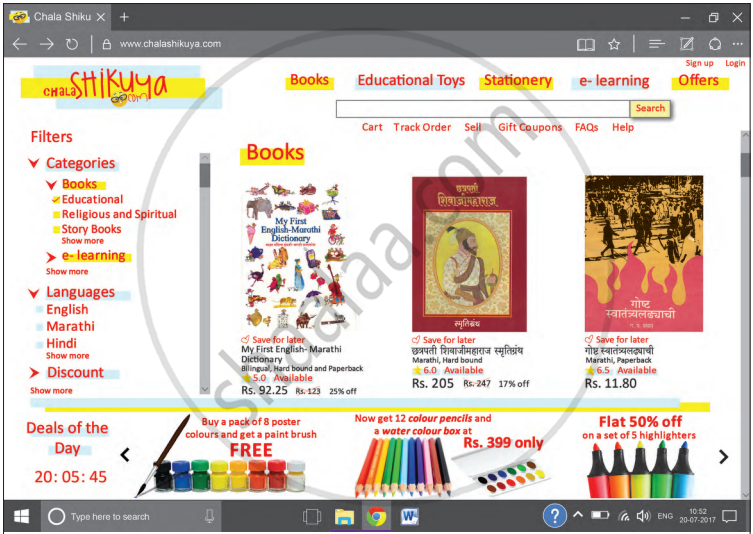
How to use this website:
- If I want to buy a story book on this website, where can I find it?
- In the categories on the left, in the options under Books you will find story books. Click that option. - I want a CD of the dictionary.
- Go to ‘e-learning’. Under that Click the ‘dictionary’ option. - Where can I look for books in the Hindi language?
-You can go to the Languages option on the left and tick the box before Hindi. - How can I find what discounts are available?
- Under the filters on left you will find discounts. - Are there any specific deals/offers on specific days?
- There is a CSY (Chalashikuya) deal. You can click on it and find out the deal of the day. - Can I purchase only one thing at a time?
- No, you can buy many things at a time. Select whatever you want and add to the cart and then browse again for another product. - When will my order be delivered?
- Maximum in 10 working days. You can also track your order by clicking the icon ‘track order.’ - There is one icon ‘Gift Coupons’. What does it mean?
- You can give a gift coupon to your friend by using this icon and he/she can purchase the product of his/her choice with the help of it. - Is this site only for purchasing?
- No, you can also sell your old books and other educational things here. - How can I find out whether the product is good or not?
- You can see the ratings and reviews of users below each product.
