Advertisements
Advertisements
Question
Read the following questions and answers. Form pairs and frame similar questions and answers for this website. How to use this website:
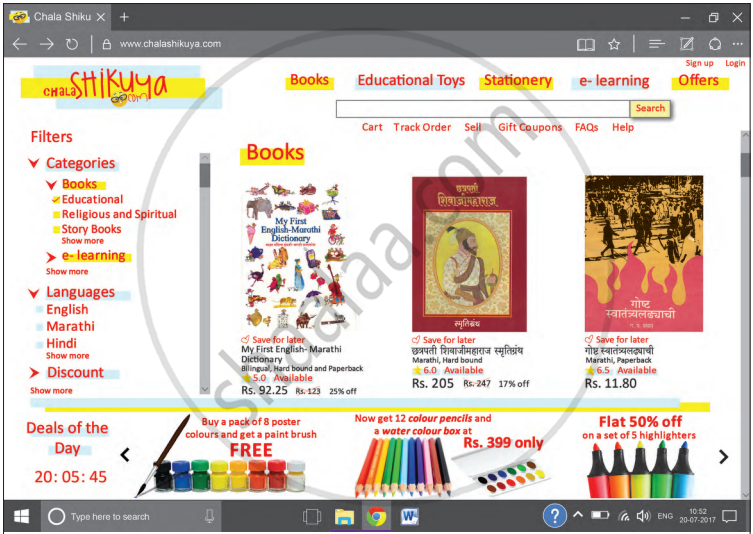
How to use this website:
- If I want to buy a story book on this website, where can I find it?
- In the categories on the left, in the options under Books you will find story books. Click that option. - I want a CD of the dictionary.
- Go to ‘e-learning’. Under that Click the ‘dictionary’ option. - Where can I look for books in the Hindi language?
-You can go to the Languages option on the left and tick the box before Hindi. - How can I find what discounts are available?
- Under the filters on left you will find discounts. - Are there any specific deals/offers on specific days?
- There is a CSY (Chalashikuya) deal. You can click on it and find out the deal of the day. - Can I purchase only one thing at a time?
- No, you can buy many things at a time. Select whatever you want and add to the cart and then browse again for another product. - When will my order be delivered?
- Maximum in 10 working days. You can also track your order by clicking the icon ‘track order.’ - There is one icon ‘Gift Coupons’. What does it mean?
- You can give a gift coupon to your friend by using this icon and he/she can purchase the product of his/her choice with the help of it. - Is this site only for purchasing?
- No, you can also sell your old books and other educational things here. - How can I find out whether the product is good or not?
- You can see the ratings and reviews of users below each product.
Advertisements
Solution
- How can I browse the various product categories accessible on the site?
- To view the various product categories on the website, select the "Categories" option on the left, under the "Filters" column. - How can I view only books in Marathi?
- Select the 'Languages' option on the left and check the box before Marathi. - Where can I get a tutorial book on this website?
- Educational literature can be found in the left categories under the heading literature. Click that option. - Is there a discount on colour pencils?
- Yes, you can purchase a set of twelve coloured pencils and a watercolour box for only 399 rupees. - Can I only buy one item at a time?
- No, you can buy more than one item at a time. First, add everything you want to your cart and click the 'buy' button.
Notes
The answers given above are for reference. Students may add additional questions and answers to the list.
APPEARS IN
RELATED QUESTIONS
Explain the use of the rhetorical device like the apostrophe by the poet.
It was roses, roses, all the way,
With myrtle mixed in my path like mad;
The house-roofs seemed to heave and sway,
The church-spires flamed, such flags they had,
A year ago on this very day.
Read the above lines and answer the question that follow.
When was the patriot welcomed?
You have recently moved to a new neighborhood in your city. Describe the new neighbourhood, comparing it to the one you have just left.
Your school recently held a jubilee celebration. Write a letter to your friend who was unable to attend, giving details of the function and your role in it.
How did the narrator and Lord Otori overpower the intruder?
Read the following passage carefully and answer the questions that follow:
Lying in bed, Swami realized with a shudder that it was Monday morning. It looked as though only a moment ago, it had been the last period on Friday; already, Monday was here. He hoped that an earthquake would reduce the school building to dust but that my good building, Albert Mission School, had withstood similar prayers for over a hundred years now.
At nine o'clock, Swaminathan wailed, “I have a headache.”
His mother said, “Why don’t you go to school in a bullock cart?”
“So that I may be completely dead at the other end? Have you any idea what it means to be jolted in a cart?”
“Have you any important lessons today?”
“Important! Bah! That geography teacher has been teaching the same lesson for over a year now. And we have arithmetic, which means for a whole period we are going to be beaten by the teacher............ Important lessons!”
And Mother generously suggested that Swami might stay at home.
At 9:30, when he ought to have been lining up in the school prayer hall, Swami was lying on the bench in Mother’s room.
Father asked him, “Have you no school today?”
“Headache,” Swami replied,
“Nonsense! Dress up and go.”
“Headache.”
“Loaf about less on Sundays, and you will be without a headache on Monday.”
Swami knew how stubborn his father could be and changed his tactics.
“I can’t go so late to class.”
“I agree, but you’ll have to; it is your own fault. You should have asked me before deciding to stay away.”
“What will the teacher think if I go so late?”
“Tell him you had a headache, and so are late.”
“He will beat me if I say so.”
“Will he? Let us see. What is his name?”
“Mr. Samuel.”
“Does he beat the boys?”
“He is very violent, especially with boys who come late. Some days ago, a boy was made to stay on his knees for a whole period in a corner of the class because he came late, and after getting six cuts from the cane and having his ears twisted, I wouldn’t like to go late to Mr Samuel’s class.”
“If he is so violent, why not tell your headmaster about it?”
“They say that even the headmaster is afraid of him. He is such a violent man.”
And then Swami gave a lurid account of Samuel’s violence; how when he started caning, he would not stop till he saw blood on the boy’s hand, which he made the boy press to his forehead like a Vermillion marking. Swami hoped his father would be made to see that he couldn’t go to his class late. But his father’s behaviour took an unexpected turn. He became excited.
“What do these people mean by beating our children? They must be driven out of service. I will see…..”
The result was that he proposed to send Swami late to his class as a kind of challenge. He was also going to send a letter with Swami to the headmaster. No amount of protest from Swami was of any avail: Swami had to go to school.
By the time he was ready, his father had composed a long letter to the headmaster, put it in an envelope, and sealed it.
“What have you written, father?” Swaminathan asked apprehensively.
“Nothing for you. Give it to your headmaster and go to your class.”
Swami’s father did not know the truth—that, actually, Mr. Samuel was a very kind gentleman.
(a) Give the meaning of each of the following words as used in the passage. (3)
One-word answers or short phrases will be accepted.
- jolted
- stubborn
- avail
(b) Answer the following questions briefly in your own words:
- What did Swami wish for on a Monday morning? Why was his wish unlikely to be answered? (2)
- Which sentence tells us that Swami’s father was completely unsympathetic to his son’s headache? (2)
- In what way was Swami’s mother’s response different from his father’s? (2)
- Why did Swami give a colourful account of Mr. Samuel to his father? (2)
- In what way did Father’s behaviour take an unexpected turn? (2)
- What was Swami finally ordered to do by his father? (2)
(c)
(i) In not more than 60 words, describe how Swami tries to prove that Mr. Samuel is a violent man. (8)
(ii) Give a title to your summary in 3
(c). Give a reason to justify your choice. (2)
Fill in each of the numbered blanks with the correct form of the word given in brackets. Do not copy the passage, but write in the correct serial order the word or phrase appropriate to the blank space.
Example:
(0) One morning, I (0) ……. (see) the python curled up on the dressing table.
Answer: saw.
It was (1) ……. (gaze) at its own reflection in the mirror. I (2) ……… (go) for grandfather, but by the time we (3) ……… (return) to the room, the python (4) …….. (move) on. He was seen in the garden, and once the cook saw him, (5) ……… (crawl) up the ladder to the roof. Then we (6) …….. (find) him on the dressing table again, (7) (admire) himself in the mirror. “He’s trying to look better for Aunt Mabel,” I said. I (8) ……. (regret) this remark immediately because grandmother overheard it and held up my pocket money for the rest of the week!
Given below is an interesting combination of words. Explain why they have been used together.
stunning artefacts
How does the bond of affection between Mrs. Croft and the narrator evolve?
Notice the use of ‘there’ in the following sentences.
-
There was a big crowd at the fair.
-
There were many things I’d have liked to buy.
Now rewrite the following sentences using ‘there’ in the beginning. Look at the following examples.
-
I can do nothing to help you.
-
There is nothing I can do to help you.
-
A man at the door is asking to see you.
-
There is a man at the door asking to see you.
1. This park has beautiful roses.
2. Your story has no fun in it.
3. We have no secrets between us.
4. My village has two primary schools.
5. This problem can be solved in two ways.
Agricultural is the principal occupation in Maharashtra that has many career opportunities.
| (a) | Agriculture Correspondent |
| (b) | Marketing Communications Manager |
| (c) | Agricultural Policy Analyst |
| (d) | Farm Management |
| (e) | Soil Conservationist |
| (f) | Scientist- Krishi Vigyan Kendra |
| (g) | Machine Design Engineer |
| (h) | Zoologist |
| (i) | Veterinarian |
| (j) | Food Microbiologist |
| (k) | Horticulturist |
| (l) | Agricultural Economics |
Write in brief about the various career opportunities given above. You can collect the information from the following universities.
- Indian Institute of Technology, Kharagpur
- Mahatma Phule Krishi Vidyapeeth, Pune.
- Dr. Panjabrao Deshmukh Krishi Vidyapeeth, Akola.
Browse on the net and gather a variety of templates to write a 'Curriculum Vitae'.
Think and respond with ‘YES’ or ‘NO’.
When you are faced with a very serious problem or some grave danger, what do you experience?
| Your feelings | panic | |
| wishing you were never born | ||
| hopelessness | ||
| helplessness | ||
| no emotion | ||
| calmness and composure | ||
| willingness to tackle it | ||
| Your reactions | break down and cry | |
| run away and hide | ||
| pray to God | ||
| ask for help | ||
| build up courage | ||
| take it as a challenge |
Now read the beginning and end of a sci-fi story given below and complete the story using your imagination.
|
‘The Magic Glasses’ After ten years of diligent experimenting on ‘light’, Jayant, a brilliant scientist, created a pair of eye-glasses which would enable him to see through all opaque objects, doors, walls, metal structures, etc. On Monday, he put on his ‘magic’ glasses and stepped into the busy street outside ____________________________ ______________________________________________________ ______________________________________________________ ______________________________________________________ ______________________________________________________ And so, Jayant received the ‘State Award for Brave Citizens’ _____________________________________________ |
Listen carefully and write the word in the appropriate column.
| Positive Feelings | Negative Feelings |
Teacher: hopeful, lonely, happy, jealous, surprised, shy, loving, proud, cheerful, anxious, nervous, excited, embarrassed, scared, silly, comfortable, peaceful, depressed, enthusiastic, motivated, inspired, threatened, crushed, angry.
Answer the following question :
What are the benefits of travel?
When you open a savings account at the bank you need to fill up Deposit forms/slips. Observe the following forms and fill up your details.

Prepare a set of questions to interview-
a person who has recently scaled Mt. Everest.
Create a poster for the following.
“Save our Earth” is the need of the hour. Draft a poster with attractive slogans/ phrases for the same in not more than 50 words. Use attractive drawings.
Draft Letter for the following.
You are Sanjay. Your colony utilizes solar energy to light the common areas. You find many friends of your colony forgetting to switch off the lights in the common area. As a responsible citizen, write a letter to a newspaper, echoing the importance to conserve and preserve solar energy.
Fill up the withdrawal form to withdraw Rs.200 from your Savings Account.

Match with and write the complete sentences below.
| A | B |
| Whenever | I go, I have friends. |
| Whoever | I am hungry, I eat. |
| Wherever | comes first, wins. |
The children in the picture are watching an exciting sporting event, where their school team is winning. Suggest suitable utterances reflecting their feelings:

Can you spot 10 differences between these pictures?

How observant are you? Individually, try to spot as many differences as possible in five minutes. If you have spotted less than five, then you really need to improve your observation skill just to save yourself from being misled.
Do you think you can afford to buy all of these at once?
Summarizing is to briefly sum up the various points from the notes made from the below passage.
The Sherpas were nomadic people who first migrated from Tibet approximately 600 years ago, through the Nangpa La pass and settled in the Solukhumbu District, Nepal. These nomadic people then gradually moved westward along salt trade routes. During 14th century, Sherpa ancestors migrated from Kham. The group of people from the Kham region, east of Tibet, was called “Shyar Khamba”. The inhabitants of Shyar Khamba, were called Sherpa. Sherpa migrants travelled through Ü and Tsang, before crossing the Himalayas. According to Sherpa oral history, four groups migrated out of Solukhumbu at different times, giving rise to the four fundamental Sherpa clans: Minyagpa, Thimmi, Sertawa and Chawa. These four groups have since split into the more than 20 different clans that exist today.
Sherpas had little contact with the world beyond the mountains and they spoke their own language. AngDawa, a 76-year-old former mountaineer recalled “My first expedition was to Makalu [the world’s fifth highest mountain] with Sir Edmund Hillary’’. We were not allowed to go to the top. We wore leather boots that got really heavy when wet, and we only got a little salary, but we danced the Sherpa dance, and we were able to buy firewood and make campfires, and we spent a lot of the time dancing and singing and drinking. Today Sherpas get good pay and good equipment, but they don’t have good entertainment. My one regret is that I never got to the top of Everest. I got to the South Summit, but I never got a chance to go for the top.
The transformation began when the Sherpa Tenzing Norgay and the New Zealander Edmund Hillary scaled Everest in 1953. Edmund Hillary took efforts to build schools and health clinics to raise the living standards of the Sherpas. Thus life in Khumbu improved due to the efforts taken by Edmund Hillary and hence he was known as ‘Sherpa King’.
Sherpas working on the Everest generally tend to perish one by one, casualties of crevasse falls, avalanches, and altitude sickness. Some have simply disappeared on the mountain, never to be seen again. Apart from the bad seasons in 1922, 1970 and 2014 they do not die en masse. Sherpas carry the heaviest loads and pay the highest prices on the world’s tallest mountain. In some ways, Sherpas have benefited from the commercialization of the Everest more than any group, earning income from thousands of climbers and trekkers drawn to the mountain. While interest in climbing Everest grew gradually over the decades after the first ascent, it wasn’t until the 1990s that the economic motives of commercial guiding on Everest began. This leads to eclipse the amateur impetus of traditional mountaineering. Climbers looked after each other for the love of adventure and “the brotherhood of the rope” now are tending to mountain businesses. Sherpas have taken up jobs as guides to look after clients for a salary. Commercial guiding agencies promised any reasonably fit person a shot at Everest.
Write an e-mail to the General Manager of a local hospital requesting him/her to send a senior doctor to talk to the participants at the event about the quality of mask which would give them the best protection.
Write the full form for the following.
wasn’t - ______
Read the given sentence and underline the no word.
I have no coat.
