Advertisements
Advertisements
Question
Read the passage carefully and complete the activities:
1. Complete the following sentences. (2)
- Female sparrows lay ____________
- Sparrows build their nest out of __________.
- The eggs are ________.
- In cities, sparrows build their nest in ______
|
A sparrow is a small bird which is found throughout the world. There are many different species of sparrows. Sparrows are only about four to six inches in length. Many people appreciate their beautiful songs. Sparrows prefer to build their nests in low places-usually on the ground clumps of grass low trees and low bushes. In cities, they build their nests in building nooks or holes. They rarely build their nests in high places. They build their nests out of twigs grasses and plant fibers. Their nests are usually small and well-built structures. Female sparrows lay four to six eggs at a time. The eggs are white with reddish-brown spots. They hatch within eleven to fourteen days. Both the male and female parents care for the young. Insects are fed to the young after hatching. The large feet of the sparrows are used for scratching seeds. Adult sparrows mainly eat seeds. Sparrows can be found almost everywhere where there are humans. Many people throughout the world enjoy these delightful birds. The sparrows are some of the few birds that engage in dust bathing. Sparrows will first scratch a hole in the ground with their feet then lie in it and fling dirt or sand over their bodies with flicks of their wings. They will also bathe in water or in dry or melting snow. Water bathing is similar to dust bathing with the sparrow standing in shallow water and flicking water over its back with its wings also ducking its head under the water. Both activities are social with up to a hundred birds participating at once and are followed by preening and sometimes group singing. |
2. How do sparrows take bathe? (2)
3. Find out adjectives for the following nouns from the passage. (2)
- ________ Song
- ________ Water
- ________ Bird
- ________ species
4. Do as directed. (2)
- A sparrow is a small bird which is found throughout the world.
(Underline the subordinate clause) - Female sparrows lay four to six eggs at a time.
(Frame a ‘wh’ type question to get the underlined part as an answer.)
5. ‘We have to save the birds.’ Do you agree with this statement? Why? (2)
Advertisements
Solution
1.
- Female sparrows lay four to six eggs at a time.
- Sparrows build their nest out of twigs, grasses, and plant fibres.
- The eggs are white with reddish-brown spots.
- In cities, sparrows build their nest in building nooks or holes.
2. A sparrow takes bath in dust, water, and dry or melting snow. It stands in shallow water and flicks water over its back with its wings. It also ducks its head under the water. Sparrows engage in dust bathing by first scratching a hole in the ground with their feet, then lie in it and fling dirt or sand over their bodies with flicks of their wings. Both these activities are social with up to a hundred birds participating at once and are followed by preening and sometimes group singing.
3.
- Beautiful Song
- Shallow Water
- Small Bird
- Different species
4.
- A sparrow is a small bird which is found throughout the world.
- How many eggs do female sparrows lay at a time?
5. Many people derive great pleasure, fulfillment, and inspiration from watching birds and listening to them. Birds keep the climate stable, oxygenate the air and transform pollutants into nutrients. Birds play an important role in the effective functioning of the ecosystem. As birds are high up in the food chain, they are also good indicators of the general state of our biodiversity. Thus, we definitely need to save birds.
APPEARS IN
RELATED QUESTIONS
B1. Complete the following statements:
(i) The poet is talking about............................. .
(ii) As a nation weare missing our .................................... .
(iii) Old people havekeys ........................... .
(iv) The elderly remember .......................... .
"Oh the value of the elderly! How could anyone not know? They hold so many keys, so many
things they can show.
We all will read the other side this I firmly believe.
And the elderly are closest oh what clues we could retrieve.
For their characters are closest to how we'll be on high.
They are the ones most developed, you can see it if you try.
They've let go of the frivolous and kept things that are dear.
The memories of so sweet, of loved ones that were near.
As a nation we are missing our greatest true resource,
To get to know our elders and let them guide our course."
B2 Express
State what the underlined words mean:
(i) Oh the value of the elderly! State the value ............. .
(ii) They are the ones most developed. 'They' stand for ............. .
B3: Match the words in Column A with their rhyming word in Column B:
| Column A | Column B |
| (i) Course | (a) Show |
| (ii) Believe | (b) resource |
| - | (c) retrieve |
What were Watson's observations on the stick left behind by Dr. Mortimer? How far did Sherlock Holmes prove him wrong? (in about 125 words)
Answer any four of the following in 30 – 40 words each
(a) What precautions were taken for the smooth conduct of Evan's O-Level examination ?
(b) How did Jo want the Roger Skunk story to end ?
(c) What makes human beings love life inspite of all the troubles they face?
(A Thing of Beauty)
(d) What is suggested by the phrase, 'massive weight of Uncle's wedding band' ?
(e) How did Douglas remove his residual doubts about his fear of water ?
(f) Why did M. Hamel write 'Vive La France' on the blackboard ?
Identify the phrases and lines that indicate distance between father and son.
“One day back there in the good old days when I was nine and the world was full of every imaginable kind of magnificence, and life was still a delightful and mysterious dream. ” The story begins in a mood of nostalgia. Can you narrate some incident from your childhood that might make an interesting story?
Discuss in groups plays or films with a strong message of social reform that you have watched.
Using a dictionary/internet note down the main difference between our strengths and our achievements.
The mother was working, when the Swallow brought the yellow jewel.
Using points from the lesson, give the details of the following in a short paragraph.
Different types of kites.
Discuss in groups and share with one another.
The daily routine of your mother and father on working days.
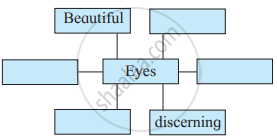
Complete the web with the help of adjectives used to describe eyes and nose in all respects. Two are done for you.

Choose the proper alternatives from the statements given below which would explain why town planning is essential - _______________.
- To develop the city according to the guidelines.
- To get the ‘Best City Award’.
- To attract tourists.
- To use and develop the land available in the city for the interest of the citizens.
Fill in the elements that you find in the drama script of ‘A Battle to Baffle.'
Characters:
- Background Scene:
- Crisis:
- Steps taken to resolve the crisis:
- Climax:
- The end:
What is described in the poem?
State whether the following statement is True or False:
Titania falls in love with an ass.
Discuss the following question after you have seen a presentation of the ‘ad’.
What would happen if you ate proper meals like rice and dal or dal-roti?
Answer the following question in one sentence.
Why does he ‘miss all the fun’?
Complete the following sentence with reference to the passage:
To this day, we venerate this tree as ____________.
List the lines that begin with 'Here' or 'And here'.
Also, list the sentences or phrases that begin with ‘And there’.
These phrases and sentences tell us about things that appear one after the other as the carriage moves. Can we tell which ones are closer to the train and which ones are at a distance? How?
Find three lines, that contain images of nature in the autumn season.
At night
- ______________________
- ______________________
- ______________________
Pick out three examples of interrogation (rhetorical questions) from the poem.
Explain in your own words the point that each one makes.
| Interrogation | Explanation |
| (1) | |
| (2) | |
| (3) |
Write in your own words.
What makes the poet remember his mother?
What do you notice about the following pairs of words?
- act naturally
- liquid gas
- open secret
- sound of silence
- sweet sorrow
- original copy
- only choice
- growing smaller
In what season does the story take place?
Imagine you are a marketing executive for a company in a specific industry (toothpaste, soup, hair care products, automobiles, etc) and are developing a product with a brand name that refers to a character from the story.
For example: You want to sell bandages that have little pictures of Don Quixote on them. Your company’s name is Kure-All and you decide to call them “Kure-All Quixote Bandages”.
The slogan might be: “Had a tough day with windmills? When you take a fall, use Kure-All.”
You can use exciting words, a catchy new slogan and a jingle among other things to promote sales of your item.
Why was the elephant owner happy with the deal?
The turtles use their flippers and make a hollow for their nests.
The girl admitted to her brother that she was badly frightened.
How do we work?
What did the first daughter do?
Try your own.
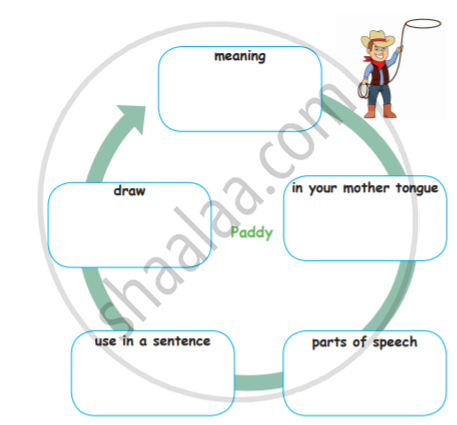
| Mr. Murugan is a farmer. He has a small piece of land and two bulls. He takes good care of his bulls as they help him in farming. Every morning, he takes the bulls for grazing. When it rains he ploughs the land with the bulls. As he has no one to help he starts sowing the seed before sunrise. He irrigates the crop till it grows. He reaps and binds the crop then takes it to thrash the paddy. Finally, with the help of the bulls, he takes the paddy to his house. |
Choose the main idea of the passage.
Find the rhyming word from the poem.
alike – _________
How does Raju help his mother?
Choose the correct answer.
Sparrow tied the elephant and the crocodile with a ______.
Read the advertisement and answer the question given below.

What is the advertisement about?
Which quality makes 'world is one and human is one'?
Divya loved solving _______.
How does she move the brush?
