Advertisements
Advertisements
Question
Prove that, in a right-angled triangle, the square of the hypotenuse is equal to the sum of the square of remaining two sides.
Advertisements
Solution 1
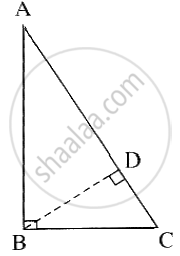
Draw perpendicular BD from the vertex B to the side AC. A – D
In right-angled ΔABC
seg BD ⊥ hypotenuse AC.
∴ By the similarity in right-angled triangles
ΔABC ~ ΔADB ~ ΔBDC
Now, ΔABC ~ ΔADB
∴ `"AB"/"AD" = "AC"/"AB"` ...(c.s.s.t)
∴ AB2 = AC × AD ...(1)
Also, ΔABC ~ ΔBDC
∴ `"BC"/"DC" = "AC"/"BC"` ...(c.s.s.t)
∴ BC2 = AC × DC ...(2)
From (1) and (2),
AB2 + BC2 = AC × AD + AC × DC
= AC × (AD + DC)
= AC × AC ...(A – D – C)
∴ AB2 + BC2 = AC2
i.e., AC2 = AB2 + BC2
Solution 2
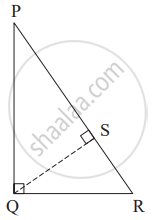
Given: In ΔPQR, ∠PQR = 90°.
To prove: PR2 = PQ2 + QR2.
Construction:
Draw seg QS ⊥ side PR such that P–S–R.
Proof: In ΔPQR,
∠PQR = 90° ...(Given)
Seg QS ⊥ hypotenuse PR ...(Construction)
∴ ΔPSQ ∼ ΔQSR ∼ ΔPQR ...(Similarity of right-angled triangles) ...(1)
ΔPSQ ∼ ΔPQR ...[From (1)]
∴ `"PS"/"PQ" = "PQ"/"PR"` ...(Corresponding sides of similar triangles are in proportion)
∴ PQ2 = PS × PR ...(2)
ΔQSR ∼ ΔPQR ...[From (1)]
∴ `"SR"/"QR" = "QR"/"PR"` ...(Corresponding sides of similar triangles are in proportion)
∴ QR2 = SR × PR ...(3)
Adding (2) and (3), we get
PQ2 + QR2 = PS × PR + SR × PR
∴ PQ2 + QR2 = PR(PS + SR)
∴ PQ2 + QR2 = PR × PR ...(P–S–R)
∴ PQ2 + QR2 = PR2 OR PR2 = PQ2 + QR2.
RELATED QUESTIONS
Prove that the diagonals of a rectangle ABCD, with vertices A(2, -1), B(5, -1), C(5, 6) and D(2, 6), are equal and bisect each other.
ABC is a right-angled triangle, right-angled at A. A circle is inscribed in it. The lengths of the two sides containing the right angle are 5 cm and 12 cm. Find the radius of the circle
D and E are points on the sides CA and CB respectively of a triangle ABC right angled at C. Prove that AE2 + BD2 = AB2 + DE2
Which of the following can be the sides of a right triangle?
2.5 cm, 6.5 cm, 6 cm
In the case of right-angled triangles, identify the right angles.
If the sides of the triangle are in the ratio 1: `sqrt2`: 1, show that is a right-angled triangle.
In triangle ABC, AB = AC = x, BC = 10 cm and the area of the triangle is 60 cm2.
Find x.
In triangle ABC, AB = AC and BD is perpendicular to AC.
Prove that: BD2 − CD2 = 2CD × AD
In the figure, given below, AD ⊥ BC.
Prove that: c2 = a2 + b2 - 2ax.
If P and Q are the points on side CA and CB respectively of ΔABC, right angled at C, prove that (AQ2 + BP2 ) = (AB2 + PQ2)
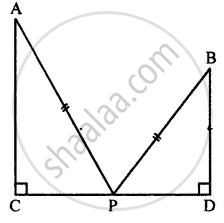
In the given figure, angle ACP = ∠BDP = 90°, AC = 12 m, BD = 9 m and PA= PB = 15 m. Find:
(i) CP
(ii) PD
(iii) CD
In the given figure, angle ACB = 90° = angle ACD. If AB = 10 m, BC = 6 cm and AD = 17 cm, find :
(i) AC
(ii) CD
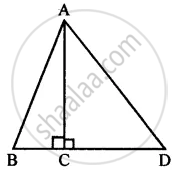
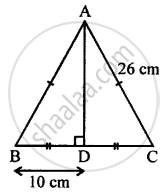
In the given figure, angle ADB = 90°, AC = AB = 26 cm and BD = DC. If the length of AD = 24 cm; find the length of BC.
A ladder, 6.5 m long, rests against a vertical wall. If the foot of the ladder is 2.5 m from the foot of the wall, find up to how much height does the ladder reach?
Two poles of height 9m and 14m stand on a plane ground. If the distance between their 12m, find the distance between their tops.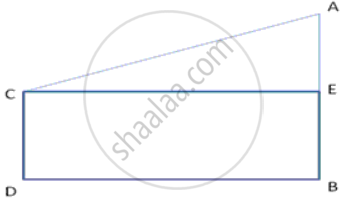
From a point O in the interior of aΔABC, perpendicular OD, OE and OF are drawn to the sides BC, CA and AB respectively. Prove that: AF2 + BD2 + CE2 = AE2 + CD2 + BF2
To get from point A to point B you must avoid walking through a pond. You must walk 34 m south and 41 m east. To the nearest meter, how many meters would be saved if it were possible to make a way through the pond?
Find the unknown side in the following triangles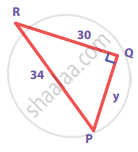
Find the distance between the helicopter and the ship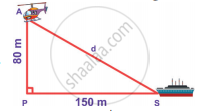
Is the triangle with sides 25 cm, 5 cm and 24 cm a right triangle? Give reasons for your answer.
If the areas of two circles are the same, they are congruent.
