Name the main nitrogenous waste in the human blood. How is it removed from the blood?
Advertisements
Question
Name the main nitrogenous waste in the human blood. How is it removed from the blood?
Advertisements
Solution
The main nitrogenous waste in the human blood is urea. The kidneys remove urea from the blood and excrete it as a dilute solution called urine.
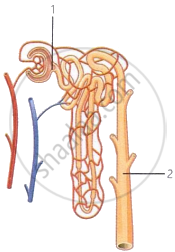
Kidneys are the main excretory organ of the human body. There are millions of nephrons in each kidney. Each nephron contains a renal corpuscle and a renal tubule. The renal corpuscle consists of capillaries called the glomerulus, enclosed by a capsule called Bowman’s capsule. The blood is filtered in the glomerulus and the filtrate travels through the renal tubules. Here, the materials needed by the body are reabsorbed, while the wastes (like urea) are collected and excreted in the urine.
APPEARS IN
RELATED QUESTIONS
Give biological reasons for the following statements: There is frequent urination in winter than in summer
Identify the odd one.
The given diagram represents a nephron and its blood supply. Study the diagram and answer the following questions:

(i) Label parts 1, 2, 3 and 4.
(ii) State the reason for the high hydrostatic pressure in the glomerulus.
(iii) Name the blood vessel which contains the least amount of urea in this diagram.
(iv) Name the two main stages of urine formation.
(v) Name the part of the nephron which lies in the renal medulla.
The diagram given alongside is that of a structure present in a human kidney:
Study the same and answer the questions that follow:
- Name the structure represented in the diagram.
- What is the liquid entering part ‘1’ called?
Name two substances present in this liquid that are reabsorbed in the tubule - What is the fluid that comes to part ‘2’ called? Name the main nitrogenous waste in it.
- Mention the three main steps involved in the formation of the fluid mentioned in (c) above.
- Name the substance which may be present in the fluid in part ‘2’ if a person suffers from Diabetes mellitus
Name the procedure used in the working of artificial kidney.
Name a waste gas released by the plants only during the day time.
Name the two waste products of the human body which are produced in the body cells.
The excretory unit in the human excretory system is called ______.
|
The organs A of a person have been damaged completely due to which too much of a poisonous waste material B has started accumulating in his blood, making it dirty. In order to save this person’s life, the blood from an artery in the person’s arm is made to flow into long tubes made of substance E which are kept in coiled form in a tank containing solution F. This solution contains three materials G, H and I in similar proportions to those in normal blood. As the person’s blood passes through long tubes of substance E, most of the wastes present in it go into solution. The clean blood is then put back into a vein in the arm of the person for circulation. |
- What are organs A?
- Name the waste substance B.
- What are (i) E, and (ii) F?
- Name G, H and I.
- What is the process described above known as?
State if the following statement is true or false. Correct the statement if it is false.
Liver produces bile pigments from the hemoglobin of broken RBCs.
Differentiate between
excretion and transpiration
Choose the correct answer:
What happens if one kidney is removed from the body of human being?
Study the diagram given alongside and then answer the question that follow:
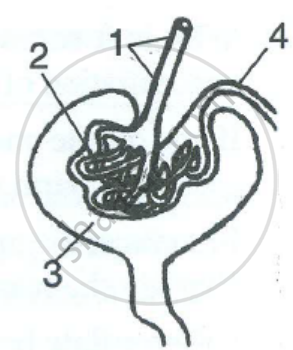
Name the parts labelled 1, 2, 3, and 4.
Study the diagram given alongside and then answer the question that follow:
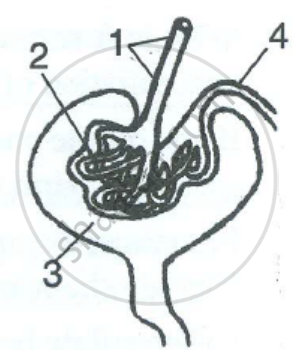
Name the stages involved in the formation of urine.
The diagram below represents a mammalian kidney tubule (nephron) and its blood supply. Parts indicated by the guidelines 1 to 8 are as follows:
1. U-shaped loop of Henle
2. Proximal convoluted tubule with blood capillaries
3. Bowman’s capsule
4. Afferent arteriole from the renal artery
5. Glomerulus
6. Venule to the renal vein
7. Collecting tubule
8. Distal convoluted tubule with blood capillaries Study the diagram and answer the following questions in each case:
(i) Where does ultrafiltration take place?
(ii) Which structure contains the lowest concentration of urea?
(iii) Which structure contains the highest concentration of urea?
(iv) Which structure contains the lowest concentration of glucose?
(v) Where is the most water reabsorbed?
Write the functional activity of the following structure:
Glomerulus
Choose the correct option.
In human beings, uric acid is formed due to metabolism of ______.
Choose the correct option.
Deproteinised plasma is not found in ______.
Answer the following question.
Amphibian tadpole can afford to be ammonotelic. Justify.
Osmoregulation maintains the osmolarity of blood at about ______.
