Name the main nitrogenous waste in the human blood. How is it removed from the blood?
Advertisements
प्रश्न
Name the main nitrogenous waste in the human blood. How is it removed from the blood?
Advertisements
उत्तर
The main nitrogenous waste in the human blood is urea. The kidneys remove urea from the blood and excrete it as a dilute solution called urine.
Kidneys are the main excretory organ of the human body. There are millions of nephrons in each kidney. Each nephron contains a renal corpuscle and a renal tubule. The renal corpuscle consists of capillaries called the glomerulus, enclosed by a capsule called Bowman’s capsule. The blood is filtered in the glomerulus and the filtrate travels through the renal tubules. Here, the materials needed by the body are reabsorbed, while the wastes (like urea) are collected and excreted in the urine.
APPEARS IN
संबंधित प्रश्न
Name the Following
The organ which produces urea.
_____________ secreted by the (ii) _____________ lobe of the pituitary gland. If this hormone secretion is reduced, there is an increased production of urine. This disorder is called (iii) ____________. Sometimes excess glucose is passed with urine due to hyposecretion of another hormone called (iv) _____________ leading to the cause of a disease called (v) ______________.
Write the functions of the Urinary bladder
With which human organ system (or human systems) is the glomerulus associated?
Name the various organs of the human excretory system.
Where is urine carried through ureters?
The procedure of cleaning the blood of a person by using a kidney machine is known as ______.
Answer the following in short.
Define transpiration in plants.
Differentiate between the following pairs of term :
Renal pelvis and renal papilla
Look at the figure given bellow, it is a section of human kidney as seen from the front.

Is it a longitudinal section or a cross-section?
The following diagram represents a mammalian kidney tubule (nephron) and its blood supply.

Parts indicated by the guidelines 1 to 8 are as follows:
1. Afferent arteriole from renal artery
2. efferent arteriole
3. Bowman’s capsule
4. Glomerulus;
5. Proximal convoluted tubule with blood capillaries;
6. Distal convoluted tubule with blood capillaries;
7. collecting tubule;
8. U-shaped loop of Henle
Study the diagram and answer the question that follow:
Where does ultrafiltration take place?
Choose the correct answer:
A condition of failure of kidney to form urea is called ____________
Choose the odd one out in the following series:
Renal fat, renal capsule, nerve.
Given below is a highly simplified diagram of the human kidney cut open longitudinally. Answer the question that follow:
Why does the cortex of the kidney show a dotted appearance?

Study the diagram given alongside and then answer the question that follow:
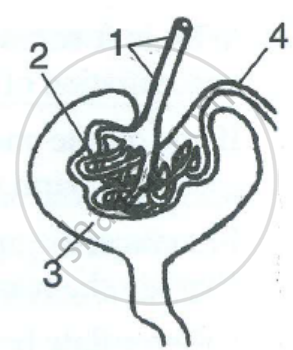
What is the technical term given to the process occurring in 2 and 3? Briefly describe the process.
Complete the following sentence with appropriate word:
The knot of blood vessel inside the Bowman’s capsule is ______.
State the Location: Renal pyramids
Choose the correct option.
Visceral layer : Podocytes :: PCT : ________.
Complete the diagram/chart with correct labels/ information. Write the conceptual details regarding it.
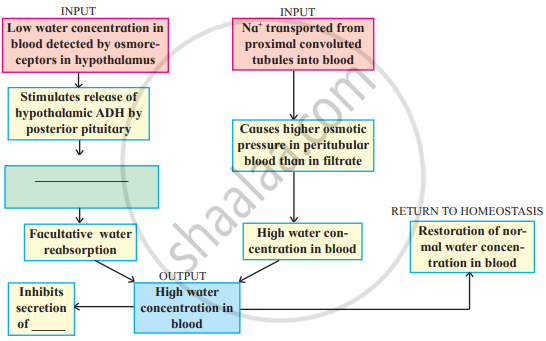
Osmoregulation maintains the osmolarity of blood at about ______.
