The procedure of cleaning the blood of a person by using a kidney machine is known as ______.
Advertisements
प्रश्न
The procedure of cleaning the blood of a person by using a kidney machine is known as ______.
विकल्प
ketolysis
hydrolysis
dialysis
photolysis
Advertisements
उत्तर
The procedure of cleaning the blood of a person by using a kidney machine is known as dialysis.
Explanation:
The process of removing waste products (urea) from the blood using a dialysis machine is known as dialysis.
APPEARS IN
संबंधित प्रश्न
How is the amount of urine produced regulated?
the Biological/technical term Pigment providing colour to urine.
The diagram given alongside shows a section of a human kidney. Study the diagram carefully and answer the questions that follow:
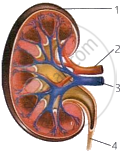
- Label the parts numbered 1 to 4.
- Why does part 2 have a striped appearance?
- What is the fluid that passes down part 4? Name the main nitrogenous waste present in it.
- Mention the structural and functional units of kidneys.
- Name the two major steps in the formation of the fluid mentioned in (c).
What gaseous waste products are excreted by plants?
Where is the dirty blood in our body filtered?
|
The organs A of a person have been damaged completely due to which too much of a poisonous waste material B has started accumulating in his blood, making it dirty. In order to save this person’s life, the blood from an artery in the person’s arm is made to flow into long tubes made of substance E which are kept in coiled form in a tank containing solution F. This solution contains three materials G, H and I in similar proportions to those in normal blood. As the person’s blood passes through long tubes of substance E, most of the wastes present in it go into solution. The clean blood is then put back into a vein in the arm of the person for circulation. |
- What are organs A?
- Name the waste substance B.
- What are (i) E, and (ii) F?
- Name G, H and I.
- What is the process described above known as?
Name the following:
The outer region of kidney containing the Bowman's capsule.
Name the following:
The vein in which urea concentration is maximum
Given below is a set of five terms. Rewrite the terms in their correct order so as to be in logical sequence.
Afferent arteriole, renal vein, secondary capillary network, glomerulus, efferent arteriole.
Choose the correct answer:
The smallest functional unit of the kidney is ____________
The diagram below represents a mammalian kidney tubule (nephron) and its blood supply. Parts indicated by the guidelines 1 to 8 are as follows:
1. U-shaped loop of Henle
2. Proximal convoluted tubule with blood capillaries
3. Bowman’s capsule
4. Afferent arteriole from the renal artery
5. Glomerulus
6. Venule to the renal vein
7. Collecting tubule
8. Distal convoluted tubule with blood capillaries Study the diagram and answer the following questions in each case:
(i) Where does ultrafiltration take place?
(ii) Which structure contains the lowest concentration of urea?
(iii) Which structure contains the highest concentration of urea?
(iv) Which structure contains the lowest concentration of glucose?
(v) Where is the most water reabsorbed?
Given below is a simple diagram of the human kidney cut open longitudinally. Answer the following questions: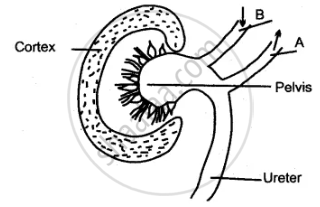
c
(v) Write two differences in the composition of the blood flowing through blood vessels A and B.
Draw a labeled diagram of the human kidney as seen in a longitudinal section.
Explain the Term: Ureter
Give a technical term:
The duct which transports urine from the kidney to the urinary bladder.
Write the functional activity of the following structure: Aldosterone
What is the purpose of making urine in the human body?
The statement given below is false. Rewrite the correct form of the statement by changing the underlined word.
The pigment urochrome is the breakdown product of the haemoglobin of dead RBCs.
