Advertisements
Advertisements
प्रश्न
The following diagram represents a mammalian kidney tubule (nephron) and its blood supply.

Parts indicated by the guidelines 1 to 8 are as follows:
1. Afferent arteriole from renal artery
2. efferent arteriole
3. Bowman’s capsule
4. Glomerulus;
5. Proximal convoluted tubule with blood capillaries;
6. Distal convoluted tubule with blood capillaries;
7. collecting tubule;
8. U-shaped loop of Henle
Study the diagram and answer the question that follow:
Where does ultrafiltration take place?
Advertisements
उत्तर
4/Glomerulus
संबंधित प्रश्न
What are the methods used by plants to get rid of excretory products?
Explain Selective reabsorption
Draw the well-labelled diagram of the human excretory system
Differentiate between the following pair on the basis of what is indicated in the bracket.
Ureter and Urethra [function]
State whether the following statement is true or false:
Some organisms store wastes in body parts.
What is the role of glomerulus in the kidney?
Study the diagram given alongside and then answer the question that follow:
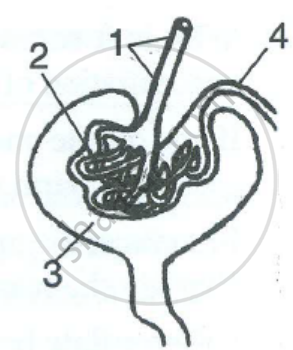
Name the stages involved in the formation of urine.
Complete the following sentence with appropriate word:
The sum total of all the chemical reactions taking place in the cell is known as ______.
Osmoregulation maintains the osmolarity of blood at about ______.
Plants use completely different process for excretion as compared to animals. Which one of the following processes is NOT followed by plants for excretion?
