Advertisements
Advertisements
प्रश्न
Explain Selective reabsorption
Advertisements
उत्तर १
Selective reabsorption:
The glomerular filtrate entering the renal tubule contains many useful substances. Hence, as the filtrate passes down the tubule, water and other substances required by the body are reabsorbed. This reabsorption occurs only to the extent that the normal concentration of the blood is undisturbed. This entire process is called selective reabsorption.
उत्तर २
Selective reabsorption:
The glomerular filtrate entering the renal tubule contains many useful substances. Hence, as the filtrate passes down the tubule, water and other substances required by the body are reabsorbed. This reabsorption occurs only to the extent that the normal concentration of the blood is undisturbed. This entire process is called selective reabsorption.
उत्तर ३
Selective reabsorption:
The glomerular filtrate entering the renal tubule contains many useful substances. Hence, as the filtrate passes down the tubule, water and other substances required by the body are reabsorbed. This reabsorption occurs only to the extent that the normal concentration of the blood is undisturbed. This entire process is called selective reabsorption.
APPEARS IN
संबंधित प्रश्न
Draw the well-labelled diagram of the human excretory system
Gums and resins are the ______ products of plants.
If a patient is out on dialysis, he is most likely suffering from a severe ailment of the ______.
Answer the following in detail.
Explain the process of transpiration. Describe some factors that affect it.
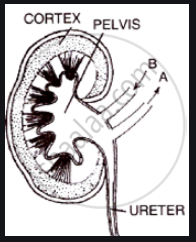
Given below is a highly simplified diagram of the human kidney cut open longitudinally. Answer the question that follow:
Write two differences in composition of the blood flowing through the blood vessels, 'A' and 'B'.
Complete the following sentence with appropriate word:
The U-shaped portion of a nephron located in the medulla region is called ______.
Answer the following question.
Name any one guanotelic organism.
The mode of excretion of nitrogenous wastes like ammonia which takes place by simple diffusion is called ______.
Bilirubin and Biliverdin are pigments which are ____________.
In a person the tubule part of the nephron is not functioning at all. What will its effect be on urine formation?
