Advertisements
Advertisements
Question
Name the following compound according to the IUPAC system.
\[\begin{array}{cc}
\ce{H2C = CH - CH - CH2 - CH2 - CH3}\\
|\phantom{...............}\\
\ce{OH}\phantom{............}
\end{array}\]
Advertisements
Solution
Hex-1-en-3-ol
APPEARS IN
RELATED QUESTIONS
Write the IUPAC name of the following compound:
\[\begin{array}{cc}
\phantom{........................}\ce{CH3}\\
\phantom{....................}|\\
\ce{CH3 - CH - CH - C - CH3}\\
|\phantom{.........}|\phantom{.........}|\\
\phantom{...}\ce{CH3}\phantom{....}\ce{OH}\phantom{....}\ce{CH3}\\
\end{array}\]
Write the IUPAC name of the following compound:
\[\begin{array}{cc}
\ce{HO - CH2 - CH - CH2 - OH}\\
|\phantom{...}\\
\ce{OH}\phantom{.}\\
\end{array}\]
Give the IUPAC name of the following ether:
CH3CH2CH2OCH3
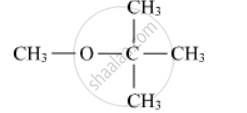
Give the IUPAC name of the following ether:

3-Methylbutane-2-ol on heating with HI gives ______
How is phenol converted into the following?
benzoquinone
Write the IUPAC name of the following compound:
Write the structures of the products when Butan-2-ol reacts with CrO3
Resorcinol on distillation with zinc dust gives _________.
Write structural formulae for 1-Ethylcyclohexanol.
Isopropyl alcohol on oxidation forms:
One of the following is not a dihydroxy derivative of benzene.
1-Propanol and 2-propanol can be best distinguished by:
\[\ce{HC ≡ CH ->[HgSO4][H2SO4] ->[CH3MgBr][H2O] ->[PBr3]}\]
What happens when benzene diazonium chloride is heated with water?
Identify A and B in the following:

Write structural formulae for:
Salicylic acid
Write IUPAC names of the following compounds:
\[\begin{array}{cc}
\phantom{...............}\ce{CH3}\\
\phantom{.............}|\\
\ce{CH3 - CH - CH - C - CH3}\\
|\phantom{......}|\phantom{......}|\\
\phantom{...}\ce{CH3\phantom{...}OH\phantom{...}CH3}\\
\end{array}\]
Write IUPAC name of the following compound:
\[\begin{array}{cc}
\phantom{................}\ce{CH3}\\
\phantom{.............}|\\
\ce{CH3 - CH - CH - C - CH3}\\
|\phantom{......}|\phantom{......}|\\
\phantom{...}\ce{CH3}\phantom{...}\ce{OH}\phantom{...}\ce{CH3}
\end{array}\]
