Advertisements
Advertisements
Question
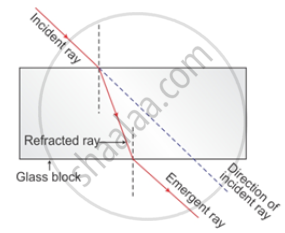
Light passes through a rectangular glass slab and through a triangular glass prism. In what way does the direction of the two emergent beams differ and why?
Advertisements
Solution
In case of a rectangular glass slab, emergent rays of light are always parallel to the direction of incident rays.
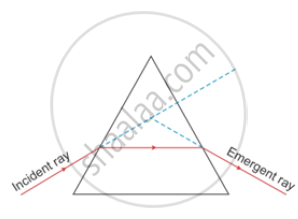
When a light ray passes through a prism, it bends towards the base of the prism. Hence, incident ray and emergent ray are not parallel to each other as they are in case of a glass slab.
APPEARS IN
RELATED QUESTIONS
Explain how the formation of a rainbow occurs.
Explain the term absolute refractive index of a medium and write an expression to relate it with the speed of light in vacuum.
Light of a single colour is passed through a liquid having a piece of glass suspended in it. On changing the temperature of liquid, at a particular temperature the glass piece is not seen. When is the glass piece not seen?
When a lighted candle is held in front of a thick plane glass mirror, several images can be seen, but the second image is the brightest, give reason.
Define the term refractive index of a medium. What do you understand by the statement 'the refractive index of glass is 1.5 for white light'?
Choose the correct alternative and rewrite the following:
A glass slab is placed in the path of convergent light. The point of convergence of light
Name the phenomenon responsible in the following case:
Twinkling of stars
Name the material for which the refractive index is found to be maximum.
A glass block is having refractive index 3/2, the light ray is incident at an angle 45°. Find the sine of the angle of, refraction inside the glass block.
