Advertisements
Advertisements
Question
Let \[A = \left\{ x: x \in N \right\}, B = \left\{ x: x - 2n, n \in N \right\}, C = \left\{ x: x = 2n - 1, n \in N \right\}\] and D = {x : x is a prime natural number}. Find: \[A \cap C\]
Advertisements
Solution
\[A = \left\{ x: x \in N \right\} = {1, 2, 3, . . . }\]
\[B = \left\{ x: x - 2n, n \in N \right\} = {2, 4, 6, 8, . . . } \]
\[C = \left\{ x: x = 2n - 1, n \in N \right\} = {1, 3, 5, 7, . . . }\]
\[\] D = {x:x is a prime natural number.} = {2, 3, 5, 7,...}
\[A \cap C\]
APPEARS IN
RELATED QUESTIONS
Draw appropriate Venn diagram for the following:
(A ∪ B)'
Draw appropriate Venn diagram for the following:
(A ∩ B)'
Draw appropriate Venn diagram for the following:
A' ∪ B'
In a survey it was found that 21 people liked product A, 26 liked product B and 29 liked product C. If 14 people liked products A and B, 12 people liked products C and A, 14 people liked products B and C and 8 liked all the three products. Find how many liked product C only.
Draw Venn diagram for the truth of the following statements :
Some rectangles are squares.
If A and B are two sets such that \[A \subset B\] then find:
\[A \cup B\]
If A = {1, 2, 3, 4, 5}, B = {4, 5, 6, 7, 8}, C = {7, 8, 9, 10, 11} and D = {10, 11, 12, 13, 14}, find:
\[B \cup C\]
If A = {1, 2, 3, 4, 5}, B = {4, 5, 6, 7, 8}, C = {7, 8, 9, 10, 11} and D = {10, 11, 12, 13, 14}, find:
\[A \cup B \cup C\]
If A = {1, 2, 3, 4, 5}, B = {4, 5, 6, 7, 8}, C = {7, 8, 9, 10, 11} and D = {10, 11, 12, 13, 14}, find:
\[A \cup B \cup D\]
If A = {1, 2, 3, 4, 5}, B = {4, 5, 6, 7, 8}, C = {7, 8, 9, 10, 11} and D = {10, 11, 12, 13, 14}, find:
\[A \cap \left( B \cup C \right)\]
Let \[A = \left\{ x: x \in N \right\}, B = \left\{ x: x - 2n, n \in N \right\}, C = \left\{ x: x = 2n - 1, n \in N \right\}\] and D = {x : x is a prime natural number}. Find: \[A \cap D\]
Let \[A = \left\{ x: x \in N \right\}, B = \left\{ x: x - 2n, n \in N \right\}, C = \left\{ x: x = 2n - 1, n \in N \right\}\] and D = {x : x is a prime natural number}. Find: \[B \cap C\]
Let A = {3, 6, 12, 15, 18, 21}, B = {4, 8, 12, 16, 20}, C = {2, 4, 6, 8, 10, 12, 14, 16} and D = {5, 10, 15, 20}. Find: \[A - C\]
Let A = {3, 6, 12, 15, 18, 21}, B = {4, 8, 12, 16, 20}, C = {2, 4, 6, 8, 10, 12, 14, 16} and D = {5, 10, 15, 20}. Find: \[C - A\]
Let A = {3, 6, 12, 15, 18, 21}, B = {4, 8, 12, 16, 20}, C = {2, 4, 6, 8, 10, 12, 14, 16} and D = {5, 10, 15, 20}.
Find: \[D - A\]
U = {1, 2, 3, 7, 8, 9, 10, 11, 12}
P = {1, 3, 7, 10} then
- show the sets U, P and P' by the Venn diagram.
- Verify (P')' = P
Represent the union of two sets by Venn diagram for the following.
A = {3, 4, 5, 7} B = {1, 4, 8}
Represent the union of two sets by Venn diagram for the following.
Y = {y | y is an odd number between 90 and 100}
Express the truth of each of the following statements using Venn diagrams:
(a) No circles are polygons
(b) Some quadratic equations have equal roots
Using the Venn diagram, examine the logical equivalence of the following statements:
(a) Some politicians are actors.
(b) There are politicians who are actors.
(c) There are politicians who are not actors.
Express the truth of each of the following statements using Venn diagram.
(1) All teachers are scholars and scholars are teachers.
(2) If a quadrilateral is a rhombus then it is a parallelogram..
From the given diagram find :
(A ∪ B)'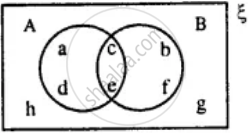
Use the given diagram to find:
(i) A ∪ (B ∩ C)
(ii) B - (A - C)
(iii) A - B
(iv) A ∩ B'
Is A ∩ B' = A - B?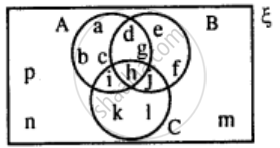
Use the given Venn-diagram to find :
A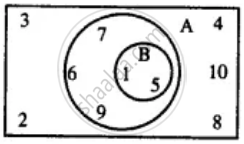
Draw a Venn-diagram to show the relationship between two overlapping sets A and B. Now shade the region representing :
A ∪ B
Two sets A and B are such that A ∩ B = Φ. Draw a venn-diagram to show the relationship between A and B. Shade the region representing :
A ∪ B
Two sets A and B are such that A ∩ B = Φ. Draw a venn-diagram to show the relationship between A and B. Shade the region representing :
B - A
Two sets A and B are such that A ∩ B = Φ. Draw a venn-diagram to show the relationship between A and B. Shade the region representing :
B ∩ A'
State the sets representing by the shaded portion of following venn-diagram :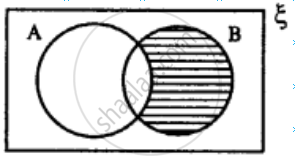
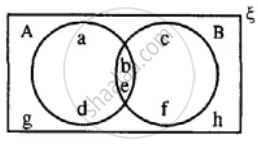
Using the given diagram, express the following sets in the terms of A and B. {a, d}
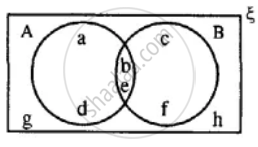
Using the given diagram, express the following sets in the terms of A and B. {a, d, c, f, g, h}
Draw a Venn diagram for the truth of the following statement.
Some share brokers are chartered accountants.
Express the truth of the following statement by the Venn diagram.
Some persons are not politician.
Draw the Venn diagrams to illustrate the following relationship among sets E, M and U, where E is the set of students studying English in a school, M is the set of students studying Mathematics in the same school, U is the set of all students in that school.
There is no student who studies both Mathematics and English.
Draw Venn diagram for the following:
No policeman is thief
Draw Venn diagram for the following:
Some doctors are rich
Take the set of natural numbers from 1 to 20 as universal set and show set X using Venn diagram.
X = {x | x ∈ N, and 7 < x < 15}
