Advertisements
Advertisements
Question
Use the given diagram to find:
(i) A ∪ (B ∩ C)
(ii) B - (A - C)
(iii) A - B
(iv) A ∩ B'
Is A ∩ B' = A - B?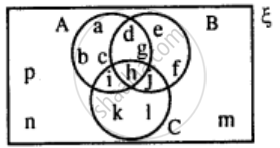
Advertisements
Solution
(i) B ∩ C = {d, e, f, g, h,j} ∩ {h, i, j, k, l}
= {h, j}
∴ A ∪ (B ∩ C) = {a, b, c, d, g, h, i} ∪ {h, j}
= {a, b, c, d, g, h, i, j}
(ii) A - C = {a, b, c, d, g, h, i} - {h, i, j, k, l}
= {a, b, c, d, g}
∴ B - (A - C) = {d, e, f, g, h, j} - {a, b, c, d, g}
= {e, f, h, j}
(iii) A - B = {a, b, c, d, g, h, i} - {d, e, f, g, h, j}
⇒ A - B = {a, b, c, i} ...(I)
(iv) B' = {a, b, c ,i, k, l, m, n, p}
A ∩ B' = {a, b, c, d, g, h, i} ∩ {a, b, c, i, k, l, m, n, p}
⇒ A ∩ B' = {a, b, c, i} ...(II)
From I and II we can conclude A ∩ B' = A - B
APPEARS IN
RELATED QUESTIONS
Draw appropriate Venn diagram for the following:
(A ∩ B)'
In a survey it was found that 21 people liked product A, 26 liked product B and 29 liked product C. If 14 people liked products A and B, 12 people liked products C and A, 14 people liked products B and C and 8 liked all the three products. Find how many liked product C only.
If A and B are two sets such that \[A \subset B\] then find:
\[A \cup B\]
If A = {1, 2, 3, 4, 5}, B = {4, 5, 6, 7, 8}, C = {7, 8, 9, 10, 11} and D = {10, 11, 12, 13, 14}, find:
\[A \cup C\]
If A = {1, 2, 3, 4, 5}, B = {4, 5, 6, 7, 8}, C = {7, 8, 9, 10, 11} and D = {10, 11, 12, 13, 14}, find:
\[A \cup B \cup C\]
From the given diagram find :
A - B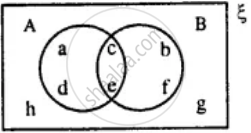
Use the given Venn-diagram to find :
B'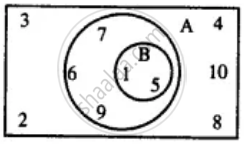
Represent the truth of the following statement by the Venn diagram.
No circles are polygons.
Represent the truth of the following statement by the Venn diagram.
All teachers are scholars and scholars are teachers.
Represent the truth of the following statement by the Venn diagram.
If a quadrilateral is a rhombus, then it is a parallelogram.
