Advertisements
Advertisements
Question
Draw a Venn-diagram to show the relationship between two overlapping sets A and B. Now shade the region representing :
A ∪ B
Advertisements
Solution
A ∪ B =
APPEARS IN
RELATED QUESTIONS
If A and B are two set such that \[A \subset B\]then find:
\[A \cap B\]
If A = {1, 2, 3, 4, 5}, B = {4, 5, 6, 7, 8}, C = {7, 8, 9, 10, 11} and D = {10, 11, 12, 13, 14}, find:
\[A \cup B\]
If A = {1, 2, 3, 4, 5}, B = {4, 5, 6, 7, 8}, C = {7, 8, 9, 10, 11} and D = {10, 11, 12, 13, 14}, find\[B \cup D\]
If A = {1, 2, 3, 4, 5}, B = {4, 5, 6, 7, 8}, C = {7, 8, 9, 10, 11} and D = {10, 11, 12, 13, 14}, find:
\[\left( A \cap B \right) \cap \left( B \cap C \right)\]
Let A = {3, 6, 12, 15, 18, 21}, B = {4, 8, 12, 16, 20}, C = {2, 4, 6, 8, 10, 12, 14, 16} and D = {5, 10, 15, 20}. Find:
\[B - A\]
Take the set of natural numbers from 1 to 20 as universal set and show set Y using Venn diagram.
Y = {y | y ∈ N, y is prime number from 1 to 20}
Express the truth of each of the following statements using Venn diagrams:
(a) No circles are polygons
(b) Some quadratic equations have equal roots
Use the given Venn-diagram to find :
B'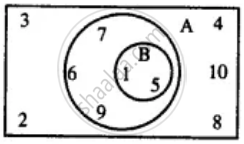
Represent the truth of the following statement by the Venn diagram.
No circles are polygons.
Represent the following statement by the Venn diagram.
Some non-resident Indians are not rich.
