Advertisements
Advertisements
Question
Let S = {a, b, c} and T = {1, 2, 3}. Find F−1 of the following functions F from S to T, if it exists.
F = {(a, 2), (b, 1), (c, 1)}
Advertisements
Solution
F: S → T is defined as:
F = {(a, 2), (b, 1), (c, 1)}
Since F (b) = F (c) = 1, F is not one-one.
Hence, F is not invertible i.e., F−1 does not exist.
RELATED QUESTIONS
Show that the function f in `A=R-{2/3} ` defined as `f(x)=(4x+3)/(6x-4)` is one-one and onto hence find f-1
Check the injectivity and surjectivity of the following function:
f : Z → Z given by f(x) = x3
Let A = R – {3} and B = R – {1}. Consider the function f : A → B defined by f(x) = `((x - 2)/(x - 3))`. Is f one-one and onto? Justify your answer.
Give examples of two functions f: N → Z and g: Z → Z such that g o f is injective but gis not injective.
(Hint: Consider f(x) = x and g(x) =|x|)
Classify the following function as injection, surjection or bijection :
f : R → R, defined by f(x) = x3 − x
Show that if f1 and f2 are one-one maps from R to R, then the product f1 × f2 : R → R defined by (f1 × f2) (x) = f1 (x) f2 (x) need not be one - one.
Find gof and fog when f : R → R and g : R → R is defined by f(x) = 8x3 and g(x) = x1/3.
Find fog and gof if : f (x) = x+1, g(x) = `e^x`
.
Let f be any real function and let g be a function given by g(x) = 2x. Prove that gof = f + f.
Consider f : R → R given by f(x) = 4x + 3. Show that f is invertible. Find the inverse of f.
Which one of the following graphs represents a function?
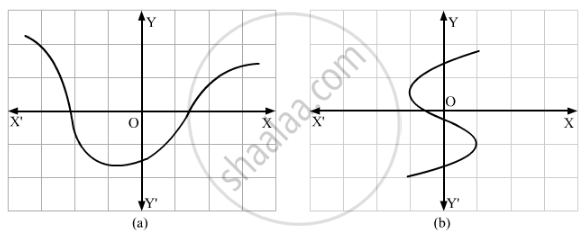
If f : C → C is defined by f(x) = x4, write f−1 (1).
Let f : R − {−1} → R − {1} be given by\[f\left( x \right) = \frac{x}{x + 1} . \text{Write } f^{- 1} \left( x \right)\]
Let `f : R - {- 3/5}` → R be a function defined as `f (x) = (2x)/(5x +3).`
f-1 : Range of f → `R -{-3/5}`.
Let f : R → R, g : R → R be two functions defined by f(x) = x2 + x + 1 and g(x) = 1 − x2. Write fog (−2).
If f(x) = 4 −( x - 7)3 then write f-1 (x).
If the function\[f : R \to \text{A given by} f\left( x \right) = \frac{x^2}{x^2 + 1}\] is a surjection, then A =
The function
Which of the following functions from
\[A = \left\{ x \in R : - 1 \leq x \leq 1 \right\}\]
\[f : Z \to Z\] be given by
` f (x) = {(x/2, ", if x is even" ) ,(0 , ", if x is odd "):}`
Then, f is
Let [x] denote the greatest integer less than or equal to x. If \[f\left( x \right) = \sin^{- 1} x, g\left( x \right) = \left[ x^2 \right]\text{ and } h\left( x \right) = 2x, \frac{1}{2} \leq x \leq \frac{1}{\sqrt{2}}\]
Mark the correct alternative in the following question:
If the set A contains 5 elements and the set B contains 6 elements, then the number of one-one and onto mappings from A to B is
Let A = R − (2) and B = R − (1). If f: A ⟶ B is a function defined by`"f(x)"=("x"-1)/("x"-2),` how that f is one-one and onto. Hence, find f−1.
For sets A, B and C, let f: A → B, g: B → C be functions such that g o f is injective. Then both f and g are injective functions.
Using the definition, prove that the function f: A→ B is invertible if and only if f is both one-one and onto
The mapping f : N → N is given by f(n) = 1 + n2, n ∈ N when N is the set of natural numbers is ____________.
An organization conducted a bike race under 2 different categories-boys and girls. Totally there were 250 participants. Among all of them finally, three from Category 1 and two from Category 2 were selected for the final race. Ravi forms two sets B and G with these participants for his college project. Let B = {b1,b2,b3} G={g1,g2} where B represents the set of boys selected and G the set of girls who were selected for the final race.
Ravi decides to explore these sets for various types of relations and functions.
- Let R: B → G be defined by R = { (b1,g1), (b2,g2),(b3,g1)}, then R is ____________.
Raji visited the Exhibition along with her family. The Exhibition had a huge swing, which attracted many children. Raji found that the swing traced the path of a Parabola as given by y = x2.
Answer the following questions using the above information.
- Let : N → R be defined by f(x) = x2. Range of the function among the following is ____________.
If f: R → R given by f(x) =(3 − x3)1/3, find f0f(x)
Let f: R → R defined by f(x) = 3x. Choose the correct answer
Let a and b are two positive integers such that b ≠ 1. Let g(a, b) = Number of lattice points inside the quadrilateral formed by lines x = 0, y = 0, x = b and y = a. f(a, b) = `[a/b] + [(2a)/b] + ... + [((b - 1)a)/b]`, then the value of `[(g(101, 37))/(f(101, 37))]` is ______.
(Note P(x, y) is lattice point if x, y ∈ I)
(where [.] denotes greatest integer function)
For x ∈ R, x ≠ 0, let f0(x) = `1/(1 - x)` and fn+1 (x) = f0(fn(x)), n = 0, 1, 2, .... Then the value of `f_100(3) + f_1(2/3) + f_2(3/2)` is equal to ______.
ASSERTION (A): The relation f : {1, 2, 3, 4} `rightarrow` {x, y, z, p} defined by f = {(1, x), (2, y), (3, z)} is a bijective function.
REASON (R): The function f : {1, 2, 3} `rightarrow` {x, y, z, p} such that f = {(1, x), (2, y), (3, z)} is one-one.
Let A = R – {2} and B = R – {1}. If f: A `→` B is a function defined by f(x) = `(x - 1)/(x - 2)` then show that f is a one-one and an onto function.
A function is called bijective if it is both:
If every seat in a classroom is occupied by one student, the situation resembles:
A perfect one-to-one matching between users and unique IDs is similar to:
